






CODESRIA Bulletin Online, No. 2, May 2026
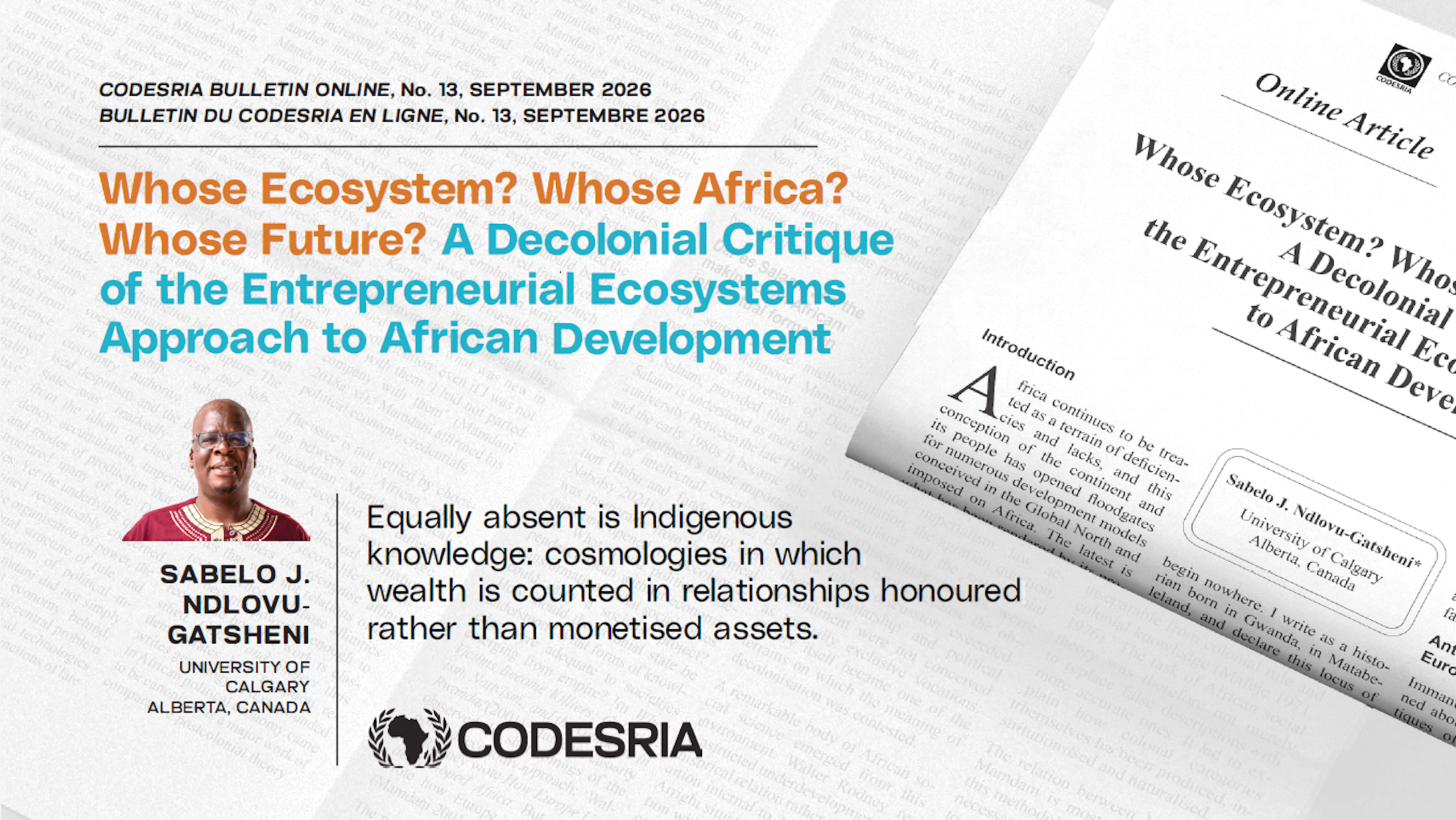
Sabelo J. Ndlovu-Gatsheni, Professor of History & Canada Research Chair Tier 1 in Pluralistic Societies: Epistemic Pluralism and Ecologies of Knowledges, Department of History, Faculty of Arts, University of Calgary, Alberta, Canada
Emails: sjndlovugatsheni@gmail.com / sabelo.ndlovugatshen@ucalgary.ca
Abstract
This article confronts the resilient and corrosive problem of comprador intellectualism and scholarship in Africa. It builds on long-standing debates about intellectuals and their social vocation, from Gramsci, Benda, Said, Dabashi, Fanon, Cabral, Mafeje, Hountondji, Mkandawire, Falola, Zeleza and Mamdani to Shivji. It argues that the cognitive empire produced not only the racialised Black subject but also a stratum of African intellectuals, whose habitus, theoretical reflexes and citation practices remain organically tied to the metropole. I propose a heuristic typology of comprador intellectualism—the Schizos, the Assimilados, the Akimbos, the Flatterers, the Reactionary Sellouts and Those Who Cry More Than the Bereaved—while also articulating five concrete consequences of this phenomenon for African societies: extraversion of research agendas; theoretical poverty and conceptual dependency; the demobilisation of African publics; the distortion of policy; and the deferral of epistemic freedom. I conclude that the resurgent and insurgent decolonisation of the twenty-first century, galvanised by #RhodesMustFall and the wider continental insurgency in knowledge, offers the most viable horizon for resolving the comprador problem and constituting a genuinely African decolonial intellectualism.
Keywords: African studies; cognitive empire; coloniality of knowledge; comprador intellectuals; decolonisation; epistemic freedom; extraversion