






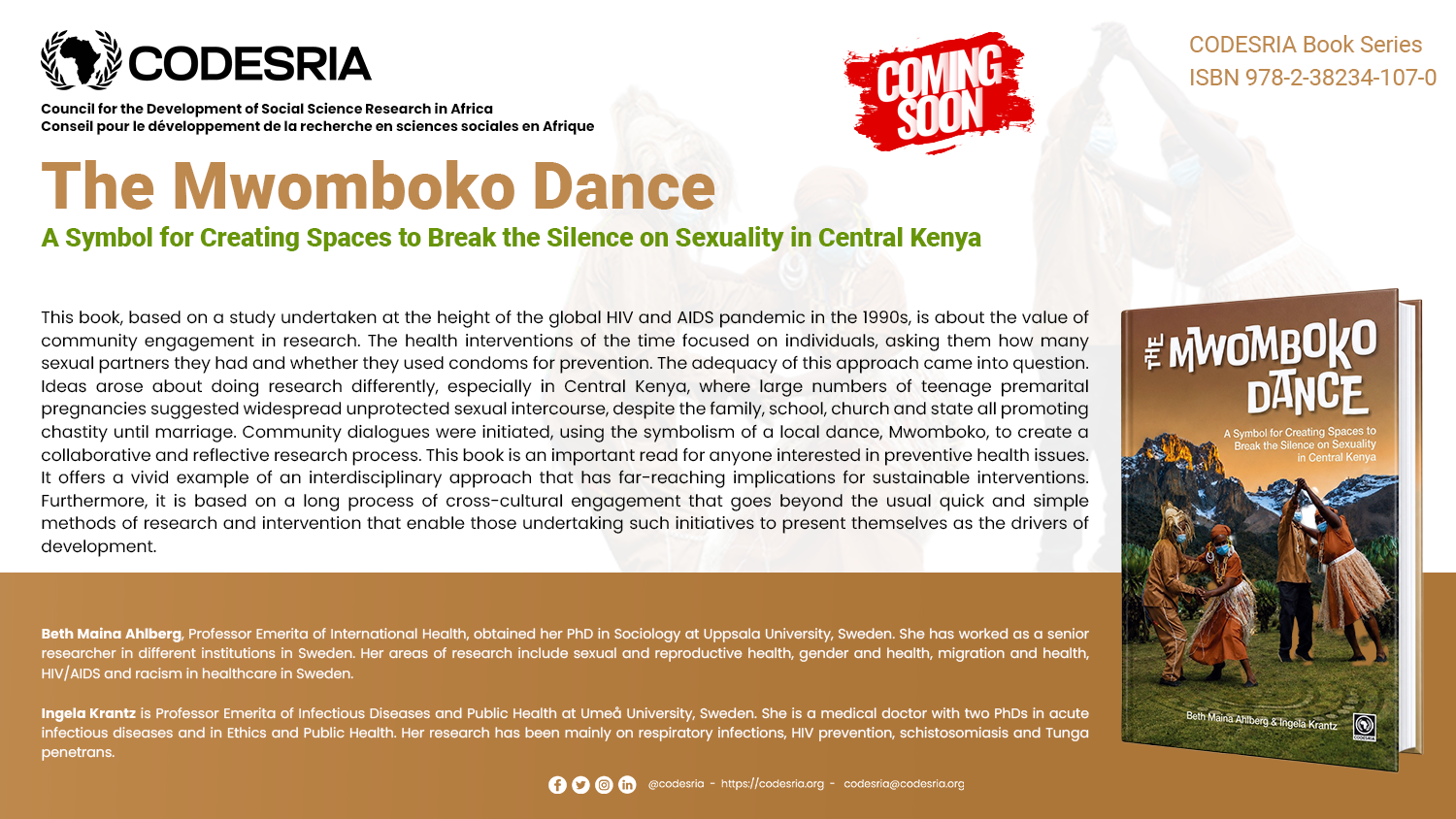
The Mwomboko Dance: A Symbol for Creating Spaces to Break the Silence on Sexuality in Central Kenya
This book, based on a study undertaken at the height of the global HIV and AIDS pandemic in the 1990s, is about the value of community engagement in research. The health interventions of the time focused on individuals, asking them how many sexual partners they had and whether they used condoms for prevention. The adequacy of this approach came into question.
Ideas arose about doing research differently, especially in Central Kenya, where large numbers of teenage premarital pregnancies suggested widespread unprotected sexual intercourse, despite the family, school, church and state all promoting chastity until marriage. Community dialogues were initiated, using the symbolism of a local dance, Mwomboko, to create a collaborative and reflective research process.
This book is an important read for anyone interested in preventive health issues. It offers a vivid example of an interdisciplinary approach that has far-reaching implications for sustainable interventions. Furthermore, it is based on a long process of cross-cultural engagement that goes beyond the usual quick and simple methods of research and intervention.
“…The book shows how the harrowing colonial violence enacted on the bodies and the social structures of the Gikuyu people is continuous with and perpetuated by the discriminatory assumptions informing global North-directed development initiatives in the global South…”
Professor Hannah Bradby, Uppsala University, Sweden
“This book is a must read for anyone working with or interested in reproductive and sexual health in Africa. This foundational research returns the rightful power to the participants by recognising their own cultural understandings and history, long lost through colonialism…”
Jill Trenholm, PhD, Women’s and Children’s Health, Uppsala University, Sweden
“…Despite a focus on the importance of context—including that of Kenya, of the HIV-AIDS pandemic, of the contradictions and paradoxes around youth and sexuality, and health communication in postcolonial times, this book is relevant in a wide range of situations and to researchers with a variety of backgrounds…”
Carol Tishelman, Professor Emerita, Karolinska Institute
Authors
Beth Maina Ahlberg
Professor Emerita of International Health, PhD in Sociology from Uppsala University. Her research areas include sexual and reproductive health, gender and health, migration and health, HIV/AIDS, and racism in healthcare.
Ingela Krantz
Professor Emerita at Umeå University. Medical doctor with two PhDs, whose research has focused on respiratory infections, HIV prevention, schistosomiasis, and Tunga penetrans.