




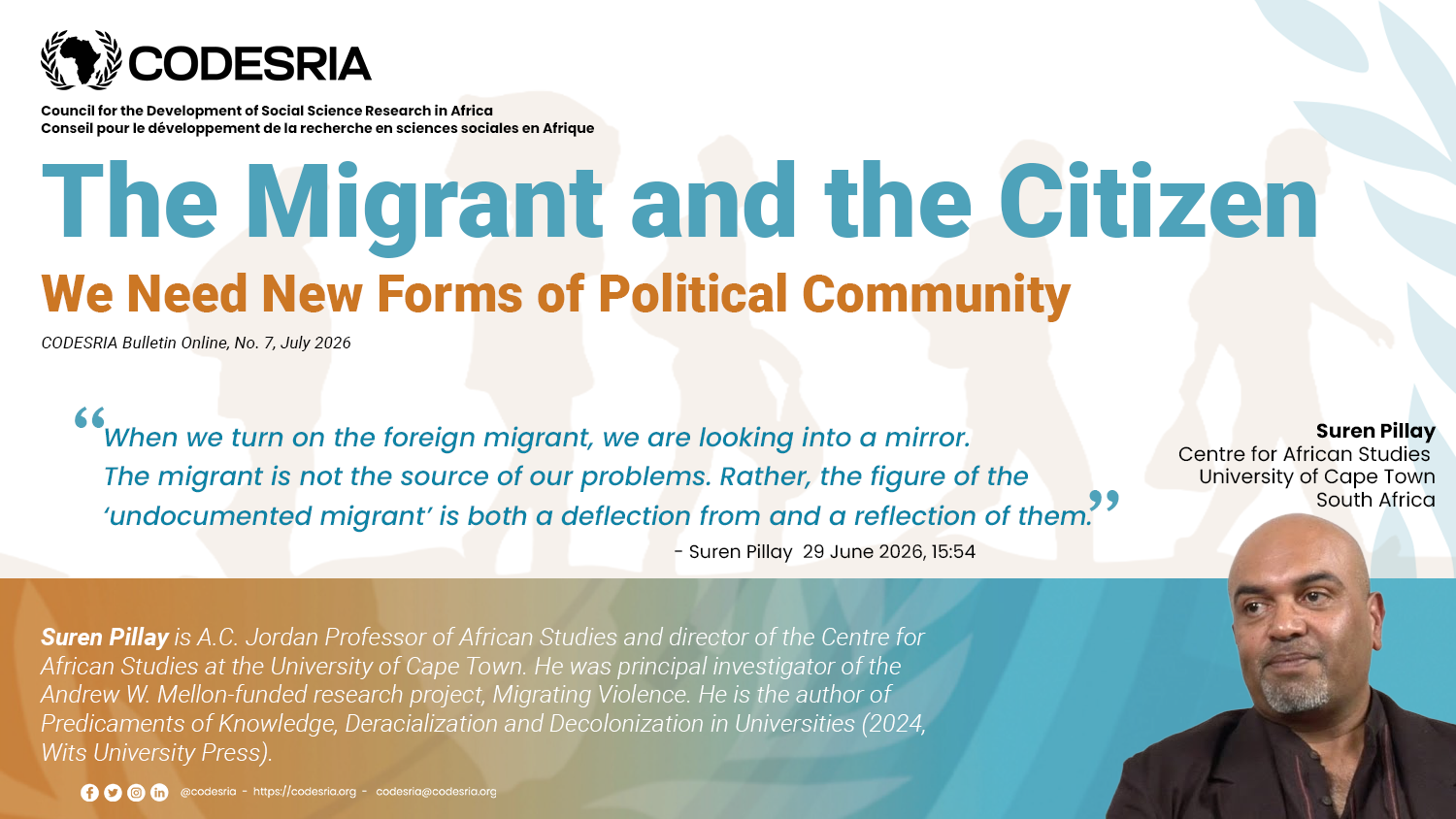
The Migrant and the Citizen: We Need New Forms of Political Community
Bulletin en ligne du CODESRIA, No. 7, Juillet 2026
by Suren Pillay, Centre for African Studies University of Cape Town South Africa
« When we turn on the foreign migrant, we are looking into a mirror. The migrant is not the source of our problems. Rather, the figure of the ‘undocumented migrant’ is both a deflection from and a reflection of them. » Suren Pillay 29 June 2026, 15:54
The history of violence in the twentieth century is filled with moments when societies have fixated on an ‘Other’ as the source of their problems, especially economic hardship. In Europe, the Jew, the Romani and later the communist occupied that role; today it is often the Muslim. During apartheid, South Africa’s Other was the ‘swart gevaar’ and the communist. In post-apartheid South Africa, it has increasingly become the migrant from elsewhere in Africa and the global South.
In South Africa, the warning signs were visible in the xenophobic attacks of 2008. Today, the sentiment there is more organised, by charismatic leaders with growing public support. Official responses have often resembled those of 2008: political leaders deny that xenophobia exists; NGOs mobilise solidarity campaigns; and academics debate labels—is it xenophobia, Afrophobia or class conflict? None of these responses is inherently wrong, but none is adequate to the politics now unfolding.