






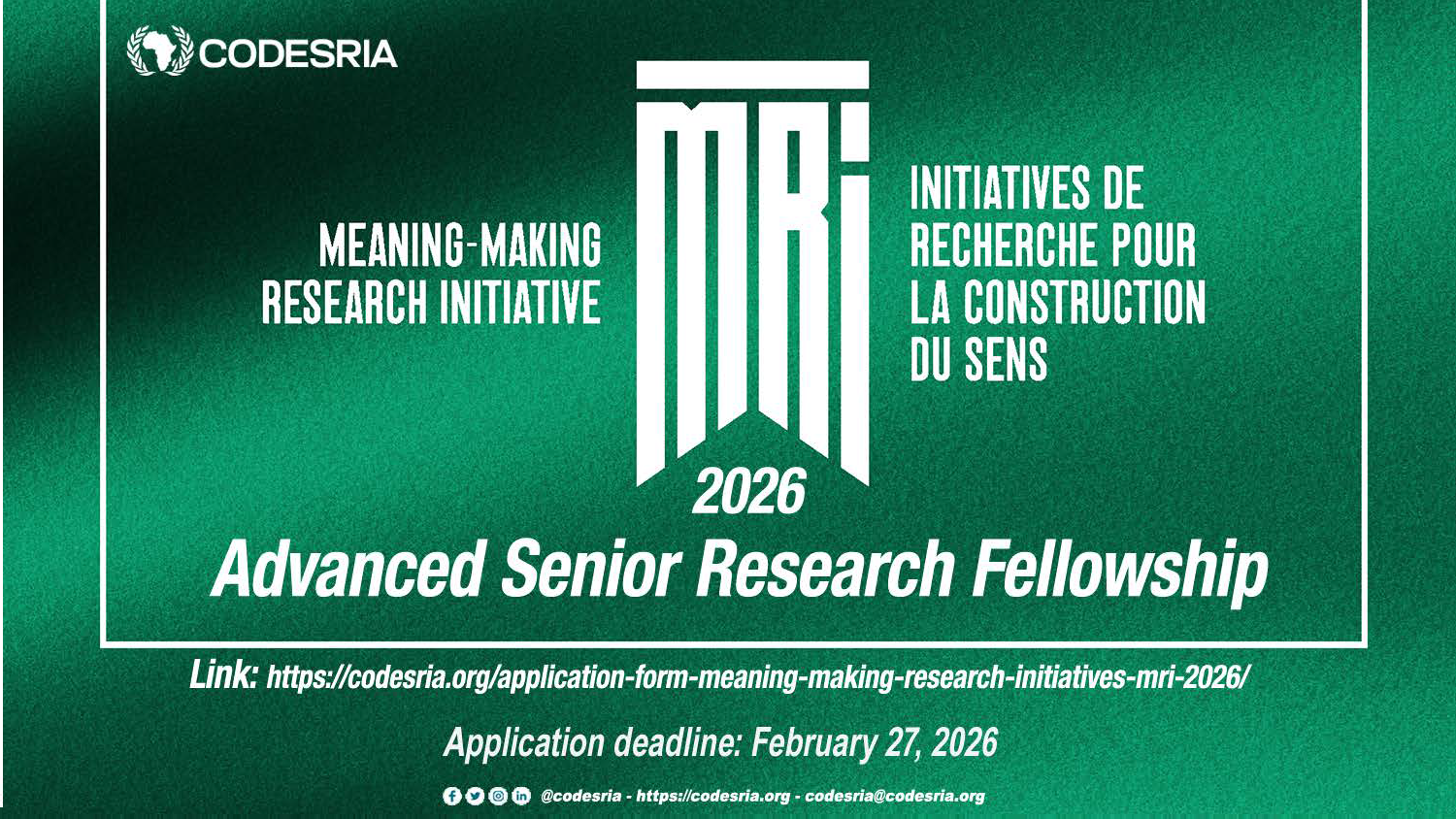
Meaning making Research Initiatives (MRI) 2026 – Advanced Senior Research Fellowship
Application deadline: February 27, 2026
Founded in 1973, the Council for the Development of Social Science Research in Africa (CODESRIA) promotes research by African scholars in the Social Sciences and Humanities with the view to better understand social phenomena in Africa. This commitment is rooted in the conviction that a sound knowledge base about the continent is invaluable to collective efforts to foster opportunity and equity, rights, and well-being in the continent.
In 2017, CODESRIA introduced the Meaning-Making Research Initiative (MRI) as its principal tool for research support. The adoption of MRI marked a renewed commit-ment to the task of interpretation and explanation that saw CODESRIA produce ground-breaking work on thematic issues such as democratization and economic re-form in Africa. The program is designed to facilitate research that contributes to agendas for imagining, planning, and creating African futures. A key objective of the MRI is to enhance the visibility of the research supported by the Council.
The Advanced Senior Research Fellowship (ASRF) builds on the foundation established by the MRI to support senior African academics engaged with relevant themes concerning African societies, particularly through conceptual reflections, demonstrating their potential to offer new analytical lenses or introduce innovative methodological approaches. The Fellowship provides scholars with an opportunity to produce high-quality, well-conceptualized and empirically robust manuscripts for possible publication by CODESRIA. All grants will be awarded to individual applicants, with each award covering a period of 16 months.
This Fellowship targets established senior scholars in based in higher education institutions in Africa. The aim is to support them to produce rigorous research work that bridges diverse geographical contexts, elevates local experiences, and introduces a robust comparative perspective capable of advancing and expanding a field of knowledge. Priority is given to those proposals with the potential to command intellectual leader-ship. The Council invite studies that advance innovative theoretical and methodological contributions of the application to the field of study. While age is important, it is not the main indicator or definition of an advanced senior scholar.
Scholars who are eligible for this support are welcome to propose alternative outputs beyond book or journal manuscripts. These might include materials that demonstrate their capacity to train younger academics, develop original teaching resources, or produce innovative audio-visual content of quality and impact comparable to a standard knowledge product. This Fellowship will be distinguishable from the other MRIs because the other MRIs focus on early to mid-career scholars. Scholars are encouraged to explore a broad range of themes, problems and questions that align with the thematic priorities outlined in the 2023-2027 CODESRIA Strategic Plan.
SELECTION CRITERIA
CODESRIA is seeking bold, innovative, and forward-looking projects that advance understanding of African social realities and agency. Successful applications are expected to:
- Address key aspects of African societies aligned with CODESRIA’s strategic priorities listed below in this call.
- Demonstrate theoretical ambition and originality, offering new analytical perspectives or methodological approaches.
- Engage with African futures and consider diversity, including gender and rural-urban contexts of the continent.
- Show familiarity with existing CODESRIA research in the area.
- Involve senior scholars with at least 15 years of post-doctoral experience.
Additional Expectations:
- Selected scholars are encouraged to engage with emerging and mid-career re-searchers.
- Accepted manuscripts will be published in the CODESRIA Monograph Series or through Council platforms.
- Priority is given to Africa-based scholars, with encouragement for applications from African female scholars and a limited number from the Diaspora.
- Although applications meeting the above criteria will be considered, the Council will give priority to projects that adopt comparative approaches.
Note: CODESRIA maintains a zero-tolerance policy regarding plagiarism. Please en-sure that the project you submit is entirely your own work.
THEMATIC PRIORITIES
All applications must align with CODESRIA’s 2023-2027 thematic priorities and cross-cutting issues. Please note that, while Higher Education Dynamics in Africa is among the Council’s thematic priorities, it has been excluded from the MRI scheme, as the Council offers dedicated research grants specifically for higher education. The following are the thematic priorities and cross-cutting issues:
1) The State and Democratisation in Africa: Trends and Prospects
This thematic priority signals the desire of the Council to reconnect with CODESRIA’s historic work on democratization processes in Africa; aiming to assess democratic transitions in Africa, in order to probe the origins, context and evolution of the transitions, examine their status, question the depth of the impact of democracy on the people and on the nature of the state, and analyse prospects for democratic consolidation in Africa. Applications can also focus on the state in Africa to illuminate the context of the evolution of politics, the deployment and use of power, the resulting impact on citizens and the implications for citizenship. Applicants are encouraged assess the current state of democracy in Africa, generating in the process a typology that might be useful for comparative work on the state and democratisation, but bearing in mind that such comparative work necessarily requires a study of the trends in global democracy processes.
2) Transformations in African Economies
This thematic priority focuses on theoretical frameworks that inform discussions on economic policy-making; the current tensions in economic development driven by orthodoxy as opposed to heterodox approaches; how these approaches refract issues of economic policy-making in Africa; discussions of dependency and structural transformation; export economies and industrialization; the issue of informalization of economies; histories and evolution of labor unionization; public-private partnership; challenges and impact of multilateral governance; the idea of planning in current economic thinking; heterodox traditions and welfare policy; alternative economic theories; reinventing economic systems; structural and institutional challenges of development; interdisciplinary and transdisciplinary conversations on economic policy; policy sovereignty for Africa, among other themes.
3) Ecologies and Society in Africa
This theme focuses on the interaction of human populations with the environment in Africa, the forms it takes, its histories and trajectories, and its impact on a broad set of sectors, including the continent’s burgeoning economies and their new capacity, whether its positive effects or negative consequences, to turn ecological inheritance (or environmental resources) into commercial products and assets. The emphasis is on interactions between people and ecological systems; targeting on land and agrarian questions, food sovereignty and poverty in the developing world; histories and trajectories of environmental interactions; the urban and the rural nexus and their complex interactions; mineral extraction and the transformation of habitats; structural transformations in agriculture and industrialization; conservancy practices, commodification and impact on societies.
Cross-cutting themes
Applications should indicate how the four cross-cutting themes that guide CODESRIA’s 2023-2027 inform their project.
a) History, Memory and Archive
b) Gender
c) Generations
d) Rurality and Urbanity
HOW TO APPLY
Interested applicants should submit application packages containing the following required materials as Word documents.
a) Applicants are required to develop a brief, to the point proposal that that provides:
i. an introduction that outlines the overarching theme and objectives;
ii. a clear statement of the key research question(s);
iii. concise review of the relevant literature, that highlights the proposal’s ex-pected contribution to existing debates;
iv. explains the theoretical significance of the study, including its anticipated contribution to knowledge production outlines
v. the research methodology to show how data or evidence will generate and analyzed;
vi. a research plan outlining key activities and timelines.
vii. Budget: a concise and realistic budget that reflects the strict 16-month duration of the grant. Click on this link to access and complete the budget template: MRI Budget Template Individual
b) Annotated plan of deliverables: One-page annotated plan for the book manuscript.
c) A letter of institutional support from a dean or any other official of the university above the dean in university hierarchy.
d) The CV of the scholar applying, including full contact details.
Applicants are reminded that proposals must be submitted in Word documents and should not exceed 12 pages including bibliography (Times New Roman, font size 12, double-spaced).
Please note that applications that lack any of these elements will not be considered.
The deadline for submission of applications is 27th February 2026, through the CODESRIA online submission system using the following link https://codesria.org/application-form-meaning-making-research-initiatives-mri-2026/
NB:
- Previous recipients of an MRI grant are ineligible and should refrain from submitting a new application.
- Applicants may submit only one application across all three categories. Multiple submissions are not permitted.
- In accordance with CODESRIA’s guidelines, this grant scheme is open exclusively to African scholars, primarily those residing on the continent, while allow-ing a limited number of applicants from the Diaspora.
- Applications from consultants or consulting firms are not eligible.
—–
MRI FAQs
- Can the proposal be submitted in languages other than English?
- Yes, proposals can be submitted in English, French, or Portuguese.
- Can I apply as an individual and also as part of a group?
- You can submit only one application: either as an individual or as part of a group. You cannot apply both ways.
- I don’t have a PhD; can I still apply for an individual initiative?
- No, PhD candidates are welcome to be part of a group but cannot apply for an individual grant. Kindly note that the grant is not intended to fund the completion of a PhD thesis.
- Can PhD students be part of a research group?
- Yes, PhD students can be members of a research group but cannot serve as the team coordinator. The coordinator must hold a PhD.
- Can male team members be included in a female-led research team for the MRI Female Scholars call?
- Yes, male team members can be included in a female-led research team, but only in exceptional cases and with proper justification.
- Must you be a member of CODESRIA to apply?
- No, you do not have to be a member of CODESRIA to apply; however, we encourage applicants to submit their membership.
- Is there a proposal template?
- There is no specific template for submitting the proposal. However, the Call for Applications outlines the key sections expected in the proposal (e.g., research questions, methodology, etc.).
- Can I re-submit a revised proposal if it was not successful in a previous call?
- Yes, you can resubmit a revised proposal in response to a new call, provided you address the feedback received and make significant improvements to the original submission.
- Are non-African nationals eligible to apply?
- Only nationals of African countries are eligible to apply for the MRI grants. While applicants may reside either on the African continent or abroad, priority is given to scholars based in Africa, in line with CODESRIA guidelines.
- What is required for the institutional affiliation letter?
- The institutional affiliation letter should confirm your association with the institution and be signed by an authorized official. Independent researchers, however, may not be required to provide this letter.
- How can I Access CODESRIA’s strategic plan?
- You can access CODESRIA’s strategic plan using this link: https://codesria.org/wp-content/uploads/2025/01/CODESRIA-Strategic-Plan_2023-2027-17122024.pdf
- Are there any limits or restrictions on the budget?
- The grant can be used to cover costs such as data collection, data analysis, books, and materials. Specific expenditures may be included in your budget as long as they are justified and within the funding limits. A budget template is provided to help you outline these costs. Please note that the grant does not cover researchers’ honoraria/fees.
- How many years of experience of post-PhD are required to apply for an MRI?
- For the General and Female Scholars’ grants, the coordinator must hold a PhD, with no requirement for the number of years since obtaining it, while applicants for the Advanced Senior Research Fellowship grant must have obtained their PhDs at least 15 years prior to the submission date.
- What is the exact budget amount for the Advanced Senior Research Fellowship grant?
- The proposed budget will be evaluated based on the needs outlined in your proposal.
- What are the main selection criteria?
- Projects should address relevant topics, adopt a strong and ambitious theoretical approach, and incorporate innovative methods. For more detailed guidelines, please refer to the specific calls for proposals.
- I am a member of an NGO/Consulting Firm; can I apply for the MRI?
- Applications from consultants and members of NGOs are not eligible. However, independent researchers are eligible to apply.
- Can a group member belong to a discipline outside of the humanities and social sciences?
- Yes, a member of a group can belong to a discipline outside of the humanities and social sciences, provided their involvement is properly justified.
- Is the MRI program open to proposals related to higher education?
- No, the MRI program does not accept proposals related to higher education. The Council has other programs that address this topic. For more information, please visit the CODESRIA website.