






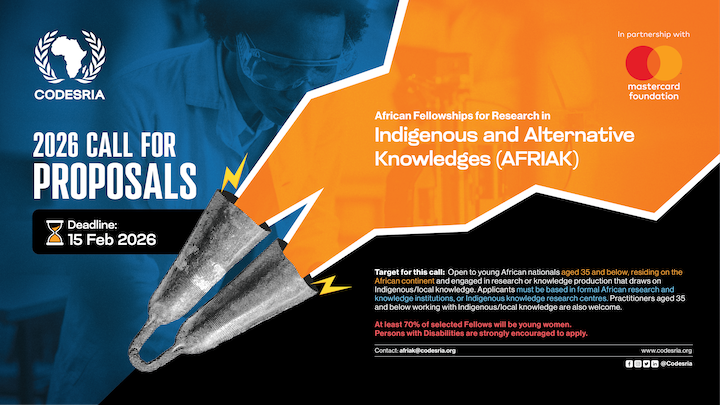
The Council for the Development of Social Science Research in Africa (CODESRIA) is pleased to announce a call for proposals for the second cohort of the African Fellowships for Research in Indigenous and Alternative Knowledges (AFRIAK). This programme is offered with the support of the Mastercard Foundation as part of the Foundation’s commitment to advance education and skills for young people in Africa.
The programme seeks to implement an innovative approach to training a new generation of young people, especially young women, to design research projects and produce knowledge in partnership with academic mentors on the one hand and bearers of indigenous knowledge on the other. This approach will privilege local, indigenous, and endogenous knowledge as forms of knowledge or knowledge systems that are deeply embedded in communities and closely tied to their lived experiences. Although these forms of knowledge may be geographically proximate to the young people in Africa, they remain inaccessible to them partly because of the dominance of Western formats of learning in our school and university curricula. They are also restricted by the gerontocratic nature of our communities, where such knowledge is preserved for a few, predominantly male knowledge-bearers. AFRIAK’s approach is innovative because it redirects us to use what we have in our communities and invites us to appreciate the diverse ways in which what we have is applied, preserved and transmitted.
At its core, AFRIAK is premised on the conviction that training a new cadre of young people with the skills to produce and apply knowledge derived from indigenous and local realities will generate unique, contextually rich and useable data. This data, we believe, contains important knowledge that will support policy interventions aimed at creating fulfilling livelihoods for young people and indigenous/local communities.
To be sure, the notion of ‘Indigenous’ is contested. Its colonial pedigree carries pejorative connotations. This research and fellowship programme seeks to critically examine and strip the term of the negative connotations, allowing for the full value of ‘what we have’ in our communities to be recognized, reclaimed and appreciated.
Previous research at CODESRIA, led by the Beninois philosopher, Paulin Hountondji, traced the problematic use of the notion to its colonial heritage and persisting scientific dependence in Africa today.[1] In colonised societies, ‘Indigenous’ was contrasted with ‘exotic’, implying that the former was native, traditional, primitive and resistant to change. Indigenous knowledge (IK) was thus framed as vernacular, uncivilised, deprived and superstitious. Hountondji analysed these forms of knowledge, noting that the persistence of the pejorative connotations made sense only in contexts of persisting extraversion of knowledge in Africa.[2] He preferred the notion of ‘endogenous’ to ‘Indigenous’ arguing that this reframing would recentre Africa in knowledge production. This programme, while acknowledging these debates and the historical baggage many terms carry, uses the notion of ‘Indigenous knowledge’ to refer to what is organic to society, to borrow from Gramsci’s concept of the organic intellectual. It underscores the idea of ‘using what we have’, while recognising that what we have in society is not static nor does it exist in splendid isolation; rather, it evolves through continuous interaction with other knowledge systems.[3]
PROGRAMME ACTIVITIES
The AFRIAK research and fellowship project will involve three related activities. These are:
- A research, training and mentorship fellowship programme for young people.
- Policy convenings.
- An alumni and community of practice in Indigenous and alternative knowledge network.
EXPECTED OUTCOMES
These three interrelated programme activities are designed to facilitate the attainment of the following outcomes:
- Create opportunities and spaces for young researchers, especially young women, to engage in multi-disciplinary knowledge production and apply it jointly with academics, activists, policy practitioners and IK-bearers and -keepers.
- Facilitate collaborative research that will minimize the isolation of Indigenous knowledge-bearers/keepers/scholars from other knowledge-bearers or -keepers and help eliminate asymmetries and silos within knowledge production systems.
- Expand opportunities to enhance the capacity of participants – especially the historically/culturally marginalized ones, including refugees, persons with disabilities, young women, and young people from rural or otherwise underserved areas – to acquire and inquire into knowledges embedded in communities.
- Transform knowledge into action while enhancing its capacity to create dignified and fulfilling work opportunities for young people in several sectors including the creative sector; digital systems, and other industries; in curriculum development, pedagogy, and learning; in climate and environment; agriculture, agri-foods systems, and nutrition ; in human, plant, and animal health, among other sectors with pressing needs and opportunities in Africa.
- Facilitate the emergence of a critical mass of young women researchers who will engage with and train future generations of IK research and practices, including embracing new technologies such as AI to mobilize and apply IK.
Overall, the project is expected to lead to the uptake and scaling of Indigenous and other forms of alternative knowledge as the basis for supporting dignified livelihood strategies for young people and communities.
RESEARCH AREAS
Proposals submitted under this call should revolve around the following themes:
- IK and methods of knowing.
- Indigenous medical science and practices.
- IK and the creative sector
- IK and systems of entrepreneurship.
- Agriculture and agri-foods systems.
- Mobilizing digital systems for IK in Africa.
- Indigenous pedagogies and curriculum development.
- IK in social capital development.
- Indigenous technologies and sustainable development
- IK, climate change, and ecological sustainability.
- IK heritage in nutrition.
- Indigenous languages and science.
- IK, religion and spirituality science.
- IK, governance systems and state-building.
TARGET FOR THIS CALL
This call targets young African nationals aged 35 and below at the time of application and who reside on the African continent. The targeted youth should be engaged in research and knowledge production activities that draw, or aspire to draw, on Indigenous/local knowledge perspectives. They should be based in formal research and knowledge institutions or Indigenous knowledge research centres in Africa. Practitioners aged 35 and below, with formal education qualifications and who are actively engaged in activities that draw on the application of Indigenous/local knowledge perspectives, are also encouraged to apply.
Up to 70 per cent of the young people to be selected for the fellowship will be young women. In line with its commitment to inclusive and equitable participation, CODESRIA strongly encourages applications from persons with disabilities. The Council has put in place safeguarding measures that will help accommodate a diverse group of successful applicants.
STRUCTURE AND DURATION OF FELLOWSHIP
The Fellowship will consist of an induction workshop, fieldwork, a residency at an intellectual hub, a virtual mid-term institute, dissemination activities, and post-Fellowship engagements, where alumni will contribute to a community of practice in indigenous and other knowledge systems. Fellows will be grouped into teams and will receive support from academic mentors, bearers of Indigenous/local knowledge and intellectual hubs – that CODESRIA has identified to enhance scholarly and community engagement. The total duration of the Fellowship is seven months. One out of the seven months will be spent at an intellectual hub in a country other than the country of citizenship of the successful applicant.
APPLICATION MODALITIES
Both Individual and Group applications are welcome.
INDIVIDUAL APPLICANTS are required to provide the following information directly in the application system: –
- Curriculum Vitae details: Applicants are expected to provide key biographical and professional information.
- Concept note: Applicants will be required to complete a structured concept note with sections that identify and elaborate on a research topic, briefly assess the body of knowledge that illuminate the research topic, methodology and expected outcomes.
- Reference letters: Applicants must attach two signed reference letters, each limited to one page, from two referees familiar with the applicant’s work. Please note that reference letters are also assessed and contribute a significant portion to the success of the application.
GROUP APPLICATIONS must consist of a minimum of three and a maximum of five members, with at least 70% of the group being women. Any group member who does not meet the eligibility criteria outlined in the ‘TARGET FOR THIS CALL’ will result in the disqualification of the entire group.
Group applicants are required to provide the following information directly in the application system: –
- Curriculum Vitae details: Applicants are expected to provide key biographical and professional information for each of the group members.
- Concept note: Applicants will be required to complete a structured concept note with sections that identify and elaborate on a research topic, briefly assess the body of knowledge that illuminate the research topic, methodology and expected outcomes.
- Reference letters: Group applicants will be required to attach two signed reference letters, each limited to one page, from two referees familiar with the group and who endorse the group as a whole, rather than its individual members. Please note that reference letters are also assessed and contribute a significant portion to the success of the application.
SUBMISSION PROCESS
Applications should be submitted through the CODESRIA portal reserved for this fellowship, at https://codesria.org/application-form-african-fellowships-for-research-in-indigenous-and-alternative-knowledges-2026/
ONLY APPLICATIONS RECEIVED VIA THIS PORTAL WILL BE CONSIDERED.
Please note that only successful applicants will be notified
The deadline for applications is 23:59 GMT on 15th February 2026.
Any queries should be directed to afriak@codesria.org
[1] Paulin Hountondji, ‘Scientific Dependence in Africa Today’, in Research in African Literatures, Vol. 21, No. 3, 1990.
[2] Paulin Hountondji, ‘Recherche et extraversion: éléments pour une sociologie de la science dans les pays de la périphérie’, in Africa Development / Afrique et Développement, Vol. 15, No. 3/4, 1990.
[3] There are similar discussions along these lines led by Yuen Yuen Ang, the Alfred Chandler Chair Professor of Political Economy at Johns Hopkins University and author of the How China Escaped the Poverty Trap.