






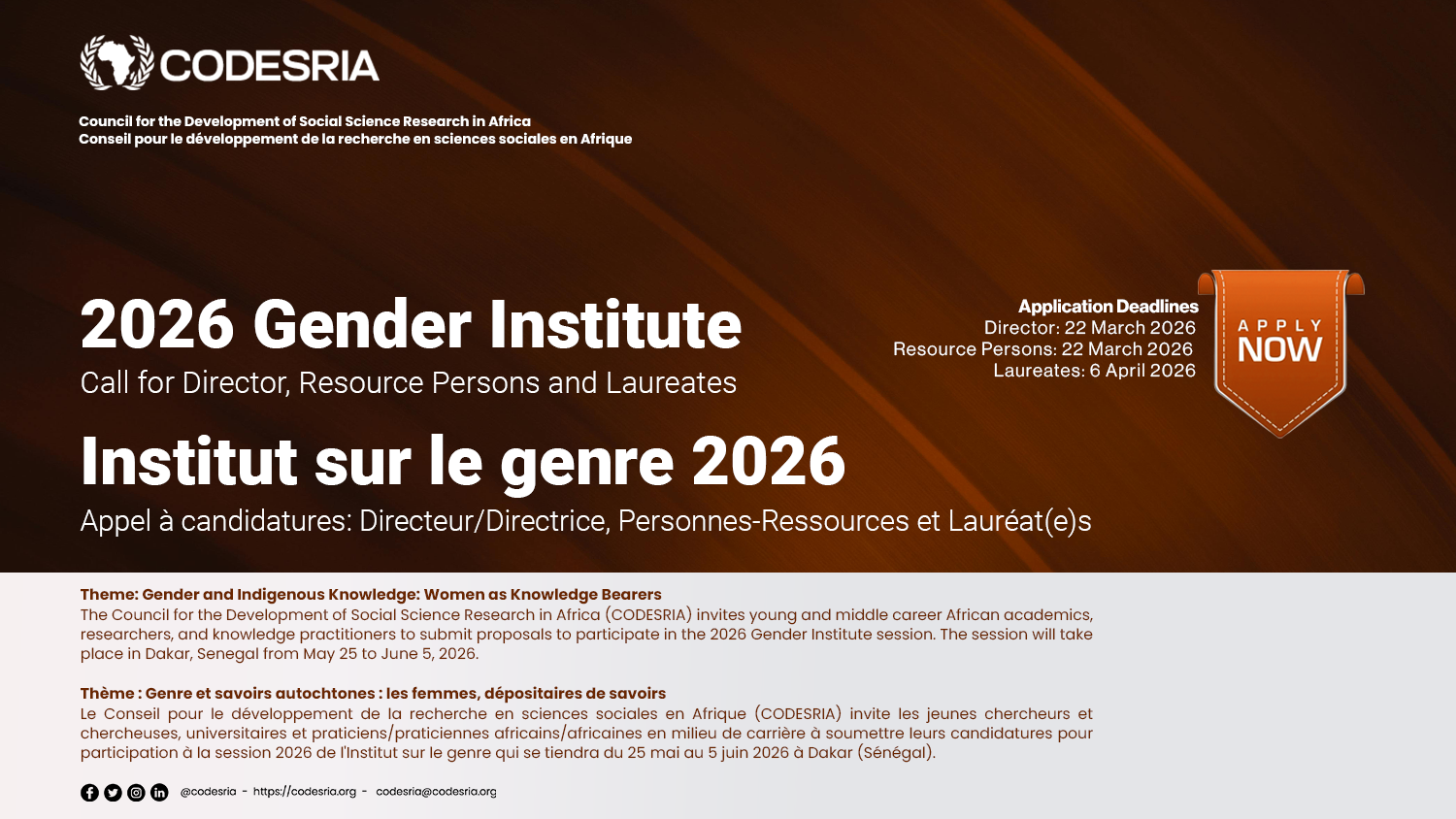
Call for Director, Resource Persons and Laureates – CODESRIA 2026 GENDER INSTITUTE
Theme: Gender and Indigenous Knowledge: Women as Knowledge Bearers
Application Deadlines:
Director: 22 March 2026
Resource Persons: 22 March 2026
Laureates: 6 April 2026
Date for the institute: 25th May – 05th June 2026
Venue: Dakar, Senegal
The Council for the Development of Social Science Research in Africa (CODESRIA) invites young and middle career African academics, researchers, and knowledge practitioners to submit proposals to participate in the 2026 Gender Institute session. The session will take place in Dakar, Senegal from May 25 to June 5, 2026.
The theme for the 2026 Gender Institute is “Gender and Indigenous Knowledge: Women as Knowledge Bearers.” This theme draws attention to the ways African women produce, preserve, and pass on indigenous knowledge in various domains, including farming, healing practices, food systems, caregiving, environmental protection, language, and community leadership. Across the continent, concrete experiences illustrate the central role women play in IK systems: in Sahelian villages, women safeguard drought-resistant seeds and ecological calendars; in countries such as Benin, Senegal, Mozambique, women healers and birth attendants maintain pharmacological and ritual knowledge essential to community health; and in major urban markets (Kumasi, Lome, Nairobi), women traders manage sophisticated savings and credit systems rooted in collective communal norms.
Although indigenous knowledge is currently regaining visibility in academic, policy, and development discourse, research centers and development agencies have historically marginalised or appropriated women’s knowledge systems within colonial and patriarchal structures of knowledge production and transmission. Scholars within feminist and decolonial perspectives have shown that women’s knowledge is frequently sidelined, or if not, it is treated as useful only in practical terms—valued for its utility rather than its theoretical and epistemic contributions.
At a time when IK is increasingly invoked in contemporary debates on African economic emergence, climate change, and sustainability—and as CODESRIA reinforces its historic role as a leading platform for the reclamation and theorisation of African ways of knowing— this Gender Institute invites participants to reflect on who defines such knowledge, who benefits from it, and how questions of ownership and authority are negotiated within African contexts. Rather than limiting itself to celebrating women’s indigenous knowledge, the Institute aims to examine the social and political conditions that shape how this knowledge is generated, shared, regulated, and sometimes contested. CODESRIA does not treat IK as a policy add-on, but rather as a site of epistemic struggle.
Of course, the notion of ‘Indigenous’ is contested and a substabtial number of researchers prefer the term endogenous. They react against the colonial inflection of the notion of indigenous that gives it pejorative connotations. In colonised societies, ‘Indigenous’ was contrasted with ‘exotic’, implying that the former was native, traditional, primitive and resistant to change. Indigenous knowledge (IK) was thus framed as vernacular, uncivilised, deprived and superstitious. Paulin Hountondji analysed these forms of knowledge, noting that the persistence of the pejorative connotations made sense only in contexts of persisting extraversion of knowledge in Africa. He preferred the notion of ‘endogenous’ to ‘Indigenous’ arguing that this reframing would recentre Africa in knowledge production.
The Institute, while acknowledging these debates and the historical baggage many terms carry, uses the notion of ‘Indigenous knowledge’ to refer to what is organic to society, to borrow from Gramsci’s concept of the organic intellectual. It underscores the idea of ‘using what we have’, while recognising that what we have in society is not static nor does it exist in splendid isolation; rather, it evolves through continuous interaction with other knowledge systems. The Institute, like our sister AFRIAK Fellowship programme, will critically examine and strip the term off the negative connotations, allowing for the full value of ‘what we have’ in our communities to be recognized, reclaimed and appreciated.
Subthemes
Applicants are encouraged to engage critically with the theme through one or more of the following interrelated sub-themes:
- African Women as Knowledge Producers
Under this subtheme, contributors may explore the many settings in which African women produce and transmit knowledge—from households and markets to spiritual spaces and community associations—and how these practices evolve across generations. Applications are invited to interrogate how epistemic authority, legitimacy, and expertise are constructed, recognised, and contested within different African contexts.
- Epistemic Injustice and the Gendered Politics of Knowledge Production
This subtheme encourages reflection on the historical processes through which women’s knowledge has been marginalised, extracted, appropriated, or rendered invisible within colonial, and patriarchal knowledge regimes. Contributions may also examine how contemporary academic practices, that privilege certain forms of expertise over others, continue to undervalue indigenous and women-centered epistemologies.
- Indigenous Knowledge, Gender, and Environmental Futures
Candidates’ proposals may address the intersections of women’s indigenous knowledge systems and contemporary environmental challenges, including climate adaptation, food sovereignty, water management, and biodiversity conservation. Particular attention may be given to the place of women’s knowledge in current environmental debates, as well as to the tensions that arise when such knowledge is drawn into policy agendas without adequate recognition of its social roots.
- Ethics, Ownership, and the Governance of Women’s Knowledge
This subtheme considers the practical and ethical questions involved when women’s knowledge is documented or translated, including issues of consent, benefit sharing, intellectual property, and the responsibilities of researchers and institutions when such knowledge is mainstreamed into academic, policy, or development frameworks.
- Feminist and Decolonial Methodologies for Engaging Indigenous Knowledge
Proposals reflecting on African feminist, decolonial, and participatory research methodologies that take women’s epistemologies as starting points for theory building are invited. Contributors are invited to discuss research approaches that respect local relationships and accountability, and to propose methods that enable collaboration with women knowledge holders rather than extracting information from them.
- Canon Formation and the Recognition of Women Knowledge Holders
This subtheme invites proposals that engage with the lives and intellectual journeys of African women whose contributions to indigenous knowledge have shaped communities, practices, and public debates, yet remain insufficiently recognised. Rather than treating these women as anonymous custodians of tradition, contributors are encouraged to examine how their trajectories, ideas, innovations, and leadership can be documented, and archived within broader intellectual histories. The aim is not to detach their knowledge from the social worlds that sustain it, but rather to think carefully about how recognition and canon formation can occur without reproducing extractive practices.
Across the different subthemes, proposals should show how women’s indigenous knowledge moves between local community life, national policy debates, and global networks, and how these different levels influence one another.
Eligibility and Selection Criteria
Director
The Director of the Institute should be a senior scholar who has demonstrated intellectual leadership and a strong record of research and publication on gender, indigenous knowledge, or closely related fields. The Director will provide the Institute’s overall intellectual direction and engage closely with laureates throughout the program.
Applicants for the position of Director should submit the following:
- A 3000 –5000 words proposal reflecting on the theme of the Institute and presenting a ten-day course outline, including key topics to be covered with laureates;
- A motivation or application letter;
- A detailed and up-to-date curriculum vitae;
- Three writing samples relevant to the theme.
Resource Persons
Resource persons are expected to be senior scholars with substantial publication record and demonstrated expertise related to the theme of the Institute. They will deliver lectures that stimulate critical reflection, debate, and engagement among laureates.
Applications for the position of resource person should include:
- A proposal of 1000 – 1500 words outlining the focus and key arguments of the proposed lecture.
- A motivation or application letter;
- A curriculum vitae;
- Two writing samples relevant to the theme;
Selected resource persons will be expected to:
- Submit lecture materials for distribution to participants at least one week before delivery;
- Deliver lectures, participate in discussions, and comment on laureates’ research proposals;
- Revise and submit their papers for possible publication by CODESRIA within two months of the Institute.
Laureates
Applicants for laureate positions should be doctoral students or early-career African researchers with demonstrated capacity to conduct research related to the theme. Indigenous knowledge practitioners active in policy spaces, social movements, traditional communities, and civic organisations are also strongly encouraged to apply.
A maximum of fifteen (15) fellowships will be awarded. A limited number of non-African scholars may be admitted if they are able to fund their participation.
Applications for laureateship should include:
- A research proposal of 800 –1000 words, outlining the topic, theoretical orientation, and relevance to the Institute’s theme;
- A letter indicating institutional or organisational affiliation;
- A detailed curriculum vitae;
- Two reference letters from scholars or researchers familiar with the applicant’s work.
Recognising diverse pathways of knowledge production, applicants who are indigenous knowledge practitioners active in policy spaces, social movements, or traditional communities may submit narrative CVs and community-based references as alternatives to standard academic documentation.
An independent selection committee composed of distinguished scholars in gender studies will review all applications.
Submission of Applications
All applications for Director, Resource Persons, and Laureates should be submitted online through the 2026 CODESRIA Gender Institute portal at the following link: https://codesria.org/application-form-2026-gender-institute/
Inquiries can be sent to tgf@codersria.org