




Academic Freedom in the Global South: Social and Institutional Lessons Learned from Latin America, the Caribbean and Africa
Presentation
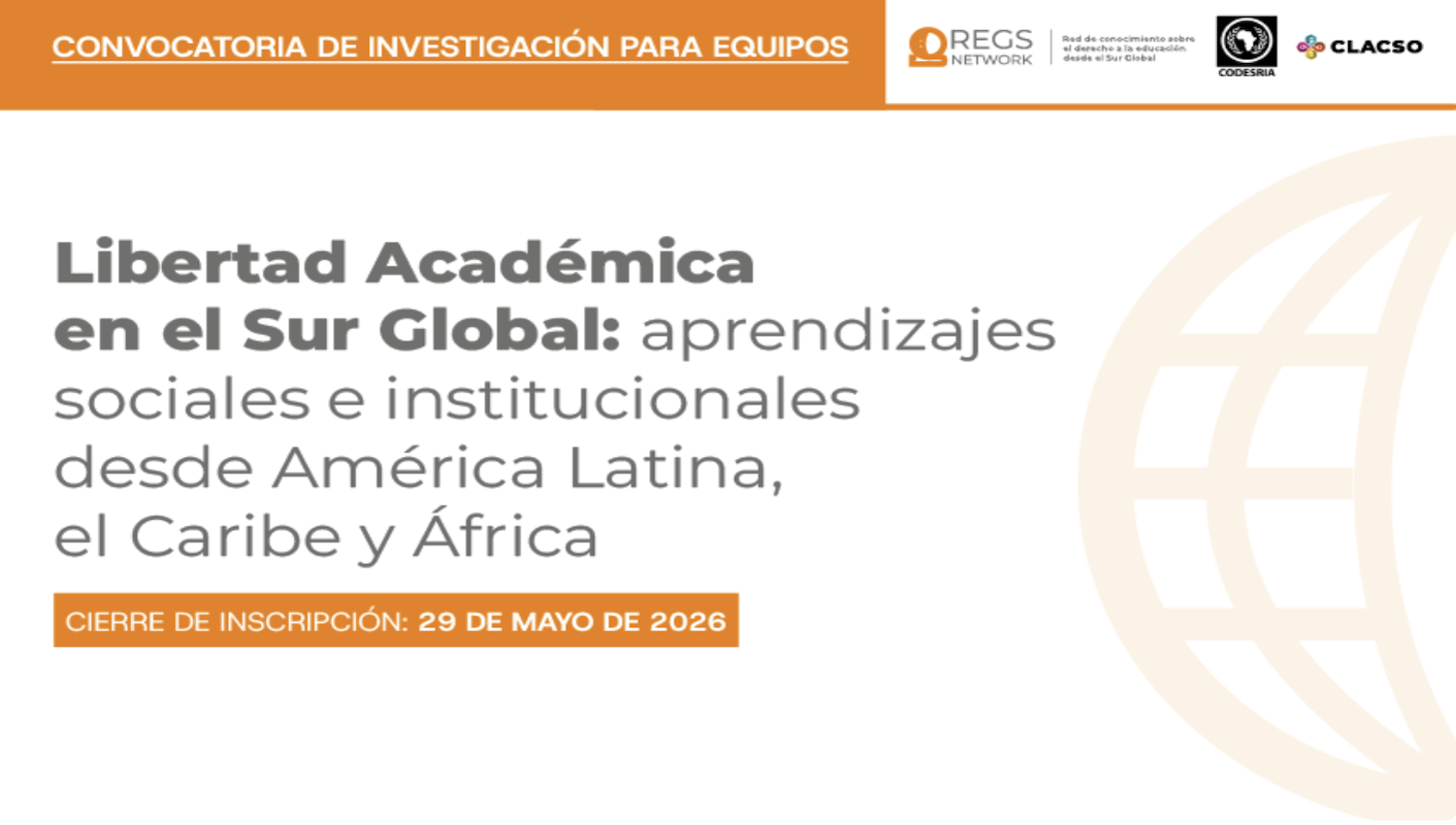
Since 2021, the Knowledge Network on the Right to Higher Education from the Global South (REGS) has been working to consolidate an international network of research, dialogue and knowledge production that problematizes educational inequalities and promotes alternative approaches to guarantee the right to education from the Global South.
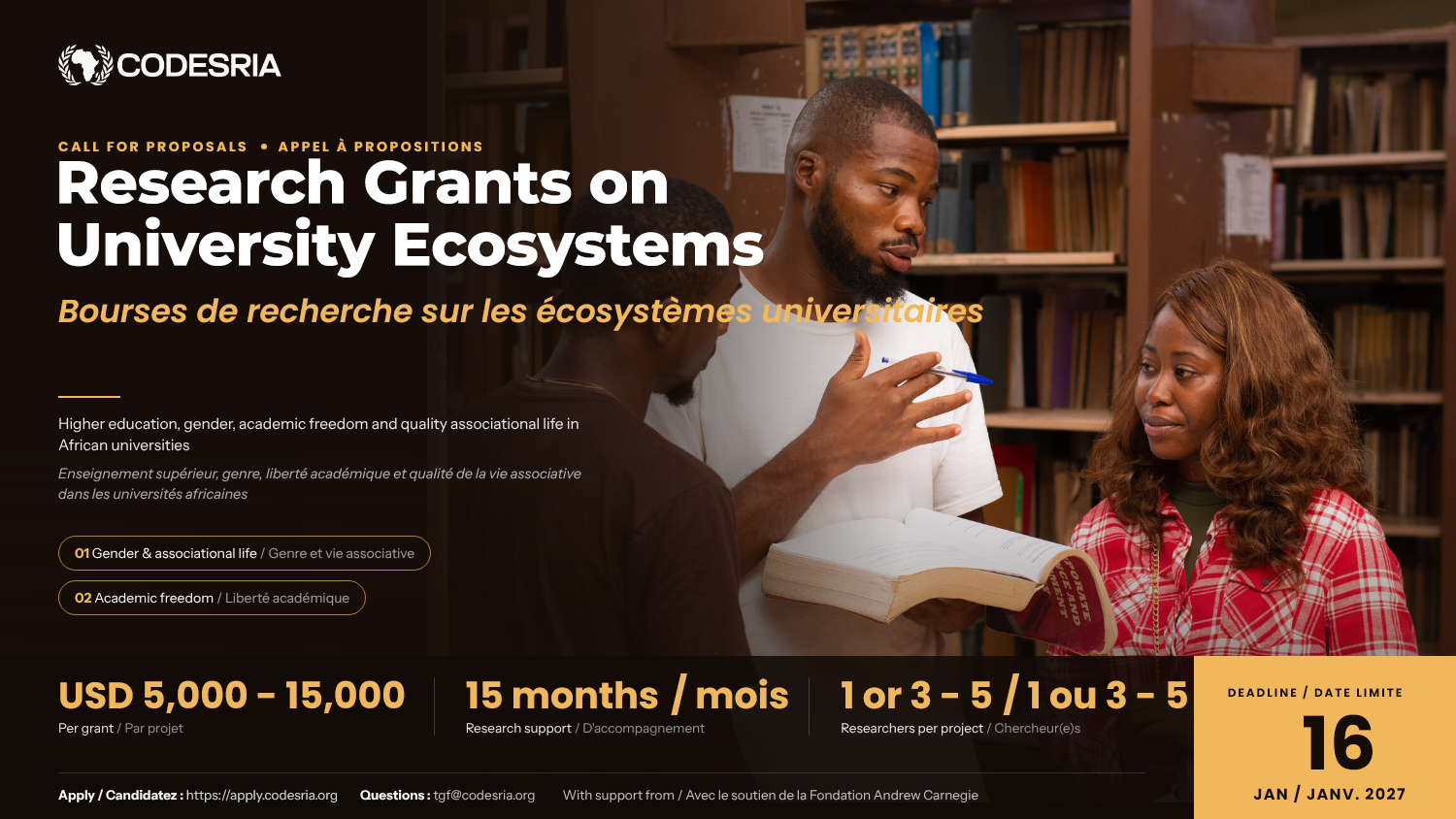
On this occasion, the Latin American Council of Social Sciences (CLACSO) and the Council for the Development of Social Science Research in Africa (CODESRIA), as part of the institutions that make up and support this network, invite research teams to submit projects that critically and contextually address the challenges of Academic Freedom in the regions of Latin America, the Caribbean and Africa.
In a global context marked by political, social, and technological transformations, academic freedom—understood not only as an individual right of faculty and students, but also as a fundamental pillar of university autonomy, democracy, and the strengthening of civic spaces—faces increasing threats. This call for proposals seeks to promote critical thinking and the production of original knowledge that allows us to understand, make visible, and defend spaces of knowledge production against censorship, harassment, precarity, and commodification, with a particular focus on fostering South-South dialogue.
Objectives of the Call
- To promote empirical and theoretical research on the state of academic freedom in Latin America, the Caribbean and Africa.
- Strengthen academic cooperation and the exchange of experiences and learning between research teams from both regions.
- To produce inputs that contribute to public debate and influence higher education policies that guarantee autonomy and the right to science.
Thematic Areas of Interest
Research projects must be registered under one or more of the following axes:
- Democracy, autonomy, and academic freedom: Impact on academic freedom, freedom of learning, and research agendas. Resistance to external pressures, harassment, and denialism.
- Academic freedom and university governance: the role of students, academic staff and faculty in university governance.
- The human right to science and knowledge: Access gaps and their impact on freedom of thought and intellectual work. Production and social circulation of knowledge as a public and common good.
- Intersectionality and Academic Freedom: Analysis of inequalities of gender, race, ethnicity, territory and class in educational, academic and scientific production trajectories.
- Socio-educational equality: Epistemic diversity and cognitive sovereignty: Dialogues between academic, ancestral, and popular knowledge. Strategies against epistemic hegemony and the defense of local knowledge systems.
- Knowledge in Resistance: Good Living and Ubuntu as horizons for a Pluriversal Academic Freedom.
- Academic freedom in the post-truth era: Disinformation, algorithms and the human right to science.
- Methodologies for the qualitative and quantitative evaluation of academic freedom in the Global South.
- Comparative studies: Transregional analyses between countries in Latin America, the Caribbean and Africa.
- Academic freedom in the digital age: Artificial intelligence, biases, data sovereignty, algorithmic justice and their implications for academic freedom.
- The university in a neoliberal context: the question of intellectual freedom, institutional and academic integrity, staff work and unionization, the commodification of education, and neo-managerialism.
For more informations, view this link https://www.clacso.org/libertad-academica-en-el-sur-global-aprendizajes-sociales-e-institucionales-desde-america-latina-el-caribe-y-africa
Registration deadline: May 29, 2026
Results announced: August 7, 2026
Research period begins: September 1, 2026
The results will be published on the CLACSO website. The winners will be contacted by email.
For questions or more information: consultabecas@clacso.edu.ar