






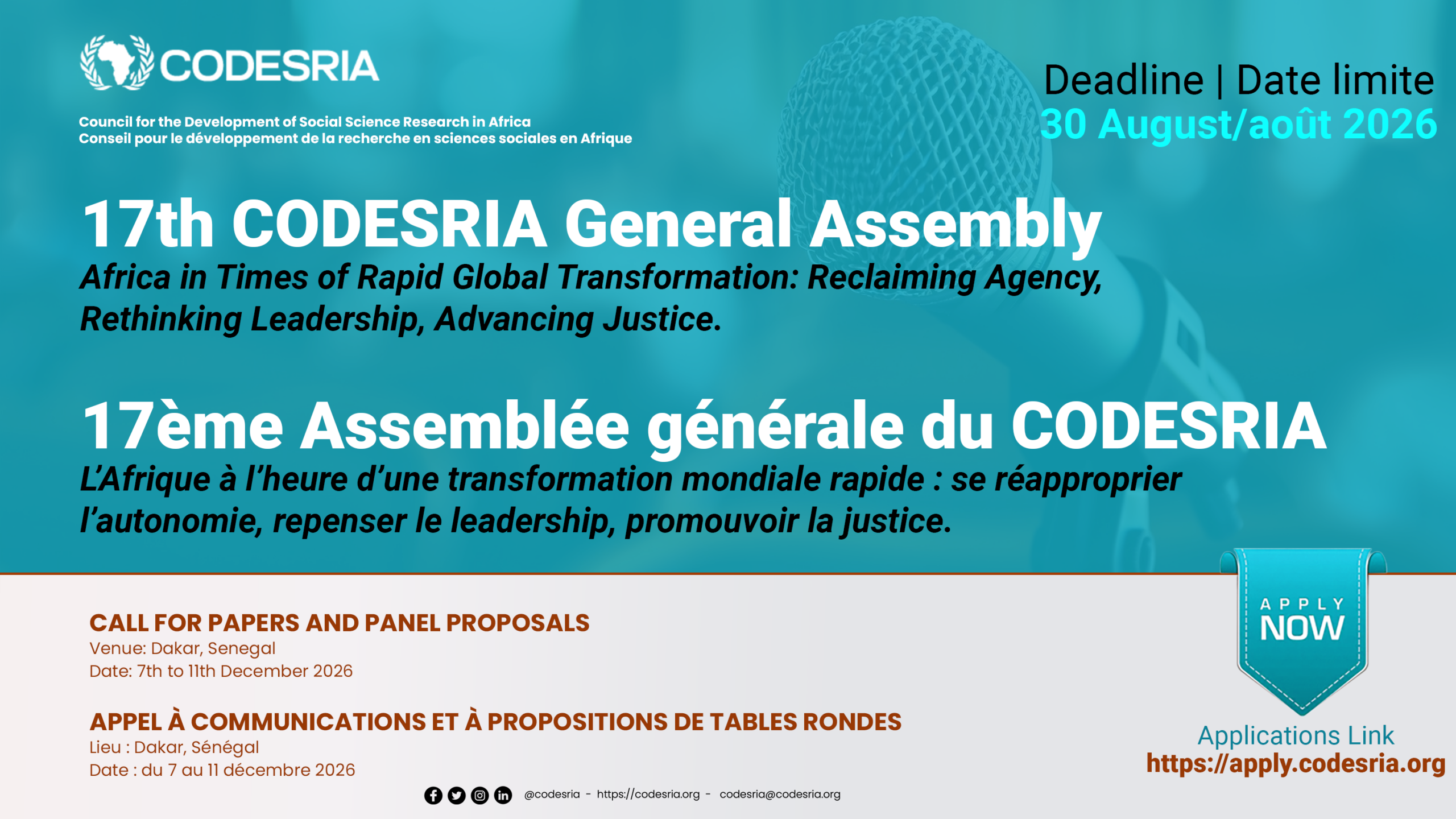
17th CODESRIA General Assembly: CALL FOR PAPERS AND PANEL PROPOSALS
Africa in Times of Rapid Global Transformation: Reclaiming Agency, Rethinking Leadership, Advancing Justice.
September 6th 2026 (extended deadline)
Venue: Dakar, Senegal
Date: 7th to 11th December 2026
The Council for the Development of Social Science Research in Africa (CODESRIA) is pleased to announce its 17th Triennial General Assembly (GA), to be held in Dakar, Senegal from the 7th to the 11th December 2026 under the theme ‘Africa in Times of Rapid Global Transformation: Reclaiming Agency, Rethinking Leadership, Advancing Justice.’ The CODESRIA GA is a triennial conference of scholars and academics primarily drawn from the humanities and social sciences in Africa and the African Diaspora. In addition to the scientific sessions of the GA, a meeting of members in ‘good standing’[1] will be convened to review the work and functioning of the Council in the period since the 16th General Assembly and to discuss the broad agenda to be pursued for the subsequent three years.
The CODESRIA GA meetings have historically been intellectual forums for robust and insightful discourses on the extant political and socioeconomic developments whose trajectories have major implications for Africa, its peoples, the state and society. In the same vein, the 17th GA is designed to provide participants the space to explore and probe, on-going rapid transformations in the global system. The idea is to highlight how the continent should position itself relative to these transformations in order to positively shape its own future and, in so doing, contribute to reshaping global affairs.
The overarching themes of agency, leadership, knowledge and justice come through strongly in the current geopolitical transformations. The menacing dangers of reinstating neo-colonial relationships stand out as a major threat for Africa. The desire in the United States of America (USA) and Europe to reinvigorate the transatlantic alliance, even if grudgingly embraced in some quarters in the USA, harks back to a world order that imagined Africa as an inferior player in that order. Matters are not helped on the African side by the persisting behaviour of most African leadership that positions itself as supplicants to dictates emanating from the global North. Participants in the GA will be encouraged to examine the current political, socio-economic, technological, climatic, and geostrategic transformations in the global system, account for these transformations, highlight their opportunities and challenges relative to Africa, and articulate appropriate African policy and positional responses in advancement of continental and diasporic African interests.
The 2026 GA comes at a time of rapid global transformation. One of the most transformative changes is the shift towards an emerging multipolar world wherein the unipolar power of the USA has come under pressure and appears to be waning while that of China is on the ascendancy. The two countries are not only in competition for global geopolitical and economic hegemony, but also for technological superiority. This development has serious implications for Africa, particularly given the continent’s central role as a source of primary resources essential to technological development and innovation. The emerging multipolarity has also witnessed the increasing ‘re-assertion’ of the European Union within the framework of NATO, this occurring mainly in response to an increasingly isolationist U.S. foreign policy, particularly under the Donald J. Trump administration. European governments have responded by increasing defence budgets while cutting funds previously dedicated to overseas development support. This, coupled with the increasing assertiveness of Global South formations – evidenced by the expansion of the BRICS bloc of countries (Brazil, Russia, India, China, and South Africa) to BRICS+ (now including Egypt, Ethiopia, Indonesia, Iran, Saudi Arabia, and the United Arab Emirates) – and the challenge to the petrodollar in the face of the U.S./ Israel war against Iran, presents both unique opportunities and challenges to African states’ agency in the global system.
At the economic level, the struggle to re-shape global economic relations persists with Africa seeking to expand its right to protect and secure its sovereignty. The struggle demands new kinds of political leadership and economic governance structures capable of mobilising Africa’s resources for the continent’s development and ensure that social justice remains integral to the work of development. Not only should the resources needed to secure Africa’s development be understood in economic terms, the definition should be expanded to include demographic, cultural and scientific resources. Concomitantly, a rethinking of Africa’s engagement with the Global North on economic matters is imperative and must foreground Africa’s economic interests and priorities, particularly in relation to natural resource extraction and the negotiation of transcontinental economic, trade, and investment initiatives.
The 2026 GA is convened in a global context marked by renewed and intensified international conflict and warfare, as well as enduring regional conflicts and civil wars some of which have become fodder for neo-colonial manipulation. This is manifested in the conflicts and wars between Russia and Ukraine; between the U.S. and Israel on one hand and Iran on the other; and in Israel’s war in Gaza and against Lebanon – a war that has gone the full extent to be described as a crime against humanity. That this war has also aimed for the destruction of institutions such as museums, hospitals and universities, to name but a few, points to growing and intentional departures from existing rules of warfare. All these have far-reaching implications for the global system in general and for Africa and African interests in particular. Furthermore, the regional African conflicts in the Democratic Republic of the Congo, South Sudan, and Sudan, among other areas, alongside the rise of xenophobic violence in parts of the world, including most importantly in South Africa, raise critical questions about the effectiveness of African governance and governments’ commitment to effective conflict resolution and to facilitating citizens’ access to basic and dignified living standards.
Simultaneously, the global system is in the throes of numerous innovations and other challenges on which the GA is invited to reflect upon. There is the catastrophic escalation of climate change on the one hand that is asserting itself alongside innovation around Artificial Intelligence (AI) on the other hand. Both are major axes of global transformations. While climate change is characterized by increasingly erratic weather patterns, AI is reshaping governance, civic engagement, and development processes. While the effect of climate change on African societies is key especially in the context of the continent’s reliance on rain-fed agriculture as the primary source of livelihoods, the transformatory promise of AI carries far-reaching implications across education, politics, healthcare and social provisioning. The GA needs to reflect on the implications of climate change on food security in Africa, or the moral-ethical extents and limits of the use of AI in research, teaching and learning, and in social representation, including reflecting on the benefits and risks of the use of AI by scholars and academics in the humanities and social sciences across their various scholarly domains of inquiry and practice. It also needs to reflect on the ways in which AI systems may construct and privilege certain understandings of reality thereby shaping how social and cultural existence is represented.
There are other axes of transformation in the contemporary global context that cannot be fully elaborated in this call. They include questions of ecology and environmental sustainability, the issue of mobility and migration, the growing struggles of marginal and marginalised communities, the place of data, knowledge and media and how they manifest differently around issues of representation. There is the obvious question of identity and how identities and identity politics are crucial to global transformations including, most importantly, identities structured around gender, race and class. The question then becomes how to strike the right balance between embracing innovative and transformative technologies and mitigating their deleterious ecological consequences.
It is not lost to the Council that the multiple, intersecting and rapid transformations highlighted above are often framed in ways that position Africa as a passive object rather than an active subject of this transformation. Central to these deliberations, therefore, is the question of African agency, not because it is unique or new to the continent, but because when African agency remains unarticulated, it opens the gate for external actors to speak for Africa, often in very patronising and matronising tones. Not only has the continent forced a rethinking around major economic questions affecting both Africa and the world – as reflected in the agenda adopted at the recent G20 meeting in Johannesburg, South Africa – but it has also assumed a leading role in advancing social justice. This is particularly evident in its response to the genocide in Gaza, with South Africa playing a major role in foregrounding accountability and mobilising international legal action. At the United Nations (UN), Africa, working with many countries in the global South, has persistently argued for the reform of the UN even if this push has been received grudgingly in the global North. The persisting struggle for a fairer global financial architecture has seen Africa, through the African Union, adopt a strong position on debt and mobilize huge constituencies not only around debt restructuring but fair terms of borrowing. In West Africa, the struggle to unshackle some West African economies from the colonial trappings of the CFA Franc constitutes a vibrant example of the long march towards economic and monetary sovereignty. The Ghana-led initiative at the UN to recognise slavery as the gravest crime against humanity also represents an instance in which the continent has helped re-shape historical memory and expand the global understanding of justice. Here, Africa remains the conscience of the world with its initiatives being embraced ever more by broad constituents including the Papacy which established the Jubilee Commission that focused on inequality and issued an urgent call for action on the debt crisis.
Sub-themes
It is against this backdrop that the Council’s 17th GA invites scholars, researchers and academics to submit papers aligned with any of the following sub-themes, which serve as entry points for interrogating the multilayered transformations outlined above. Where a proposed application does not fit in any of the themes, the Council’s review team will be open to additional proposals so long as they demonstrate their relevance to the overall theme of the 17th GA.
Defining global transformations.
- Understanding the contours of rapid global transformation.
- The humanities and social sciences during rapid global transformations.
Beyond the Unipolar World
- Beyond the unipolar world: The contours of the transition.
- Multilateralism and the fate of international organizations.
- The global peace and security architecture in a multipolar world.
- New players under a new world Order: The role of BRICS+
A Matter of Voice: Africa’s Foreign Policy
- A Question of Agency? Africa in global Transitions and Transformations.
- Rethinking African foreign policy in a context of shifting global order
- A deepening multipolarity? Implications for Africa.
Education and the Role of Knowledge
- Knowledge and Ways of Knowing in a new world.
- The African Higher Education Sector in a reordering world
- Artifical Intelligence and global transformations.
- Dilemmas of Artificial Intelligence applications.
- Indigenous Knowledge Systems and Epistemic Justice
Citizenship & the National Question
- The State and the question of Citizenship
- African State and the emerging new world order.
- From National to Pan-African: Rethinking the question of citizenship
Movements, Justice and Inclusivity
- Gendered dimensions of a rapidly transforming global system
- Women Movements restructuring global Order
- Transformations through protests
Youth, Leadership and Creatives
- The Youth Question in a changing world
- Youth, protests and reconfiguration of governance in Africa
- Reconfiguring global governance architectures.
- Youth as leadership outside political spaces.
- Sports, music, & the arts in reconfiguring global architectures.
Belonging away from Home
- Prospects of a Borderless Africa in a new global order.
- Migration, mobility and displacement.
- Citizenship, Xenophobia to Afrophobia.
Regional Communities and Regional Integration
- Geopolitics and Africa’s dynamics of Regional Integration.
- Regional integration and the African Continental Free Trade Area
- Africa and the dynamics of International Trade.
Governing a dismembered continent
- Anti-imperialism and the rise of new African political leadership
- Regional Conflict, External Interventions, and African Sovereignty.
Waterways and the African Seas
- Geopolitics of African Seas
- Maritime commerce and African economies
Ecology and Society
- Redefining the Challenge of climate change.
- Climate change and the imperatives of sustainable development.
- Climate change, Agriculture and Food Security
- Rethinking Africa’s mining compacts
- African resources and the U.S.-China technological rivalry
- The Politics of controlling rare earth minerals.
The Fate of Agriculture and Industry
- Agriculture and Food Security in Africa
- Local Manufacturing/industrialization in Africa
- Land, labour, and global transformations
Global systems of justice and implications for Africa
- Human rights, justice and accountability in a changing World
- Inequalities, Poverty and Social Justice
- The media, democratization, and social representation
Submission of Abstracts and Panel Proposals
Academics, researchers and scholars wishing to be considered for participation in the 17th GA as paper presenters or panel convenors are invited to submit abstracts for papers or panel proposals for consideration by the CODESRIA Scientific Committee by September 6th 2026 (extended deadline). Successful applicants will be notified by 30th September 2026 to submit full papers for a second round of review. Authors of selected papers and panels will be informed on 30th October 2026.
- Abstracts for paper presentation should not exceed 500 words
- Panel proposals should not exceed 1,000 words.
- Each submission should clearly indicate the sub-theme in which they are located.
- Submissions may be made in English, French, or Portuguese
- All submissions should be made exclusively through the submission portal at: https://apply.codesria.org/. No email submission will be accepted.
For any queries relating to this call, please contact general.assembly@codesria.org
[1] Refer to the CODESRIA Charter Article 17A