






Call for Proposals: Research Grants on University Ecosystems
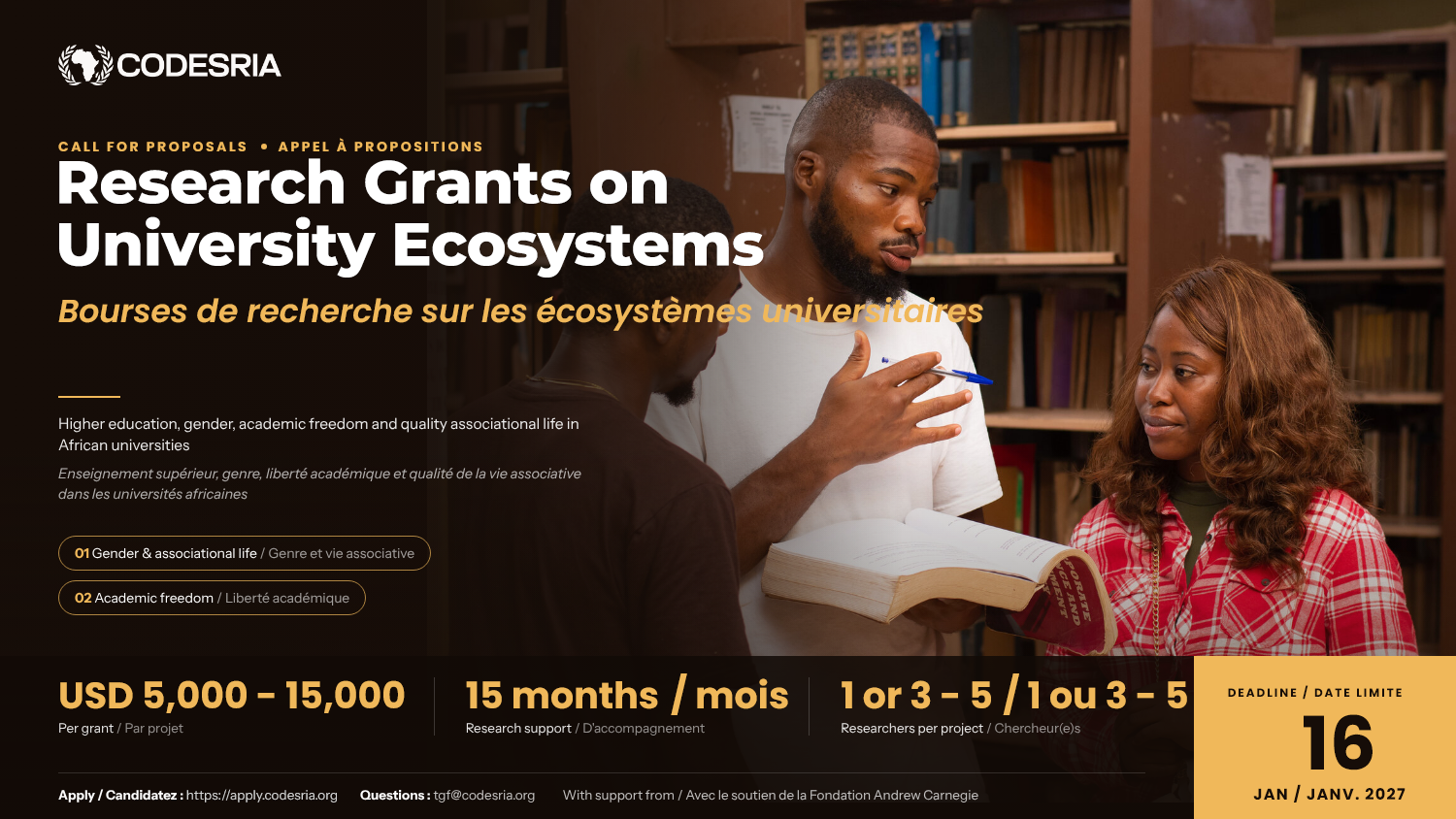
Higher Education, Gender, Academic Freedom and Quality Associational Life in African Universities
The Council for the Development of Social Science Research in Africa (CODESRIA) is a pan-African social science and humanities organisation headquatered in Dakar, Senegal. Founded in 1973, the organisation has defined its core agendas with the aim of supporting the higher education sector in Africa. Though the focus remains on social sciences and humnities, its programming in support of the higher education is expanding and includes interventions that aim at enhancing the vibrancy of this sector. The Council’s programming and research support in higher education has been anchored in the realization that higher education is inseparable from the broader social, political, and economic dynamics shaping the African continent. In line with this commitment, the Council is coordinating a series of interventions to strengthen research capacity, promote gender equality, and support academic freedom in African universities.
With funding support from the Andrew Carnegie Foundation, this current call is seeking proposals from researchers in African universities and research institutions to undertake interventions revolving around higher education, gender, academic freedom and the quality of associational life in African universities. The project aims at supporting research and knowledge production that will foreground the four interlinked domains shaping contemporary debates on the university in Africa: the evolving landscape of higher education; the persistent and emergent gendered dynamics within academic spaces; the contested terrain of academic freedom; and the conditions that enable or constrain vibrant, inclusive associational life on campus. Embedded within the broader need to reimagine the role of the university in Africa; one that centres epistemic justice, inclusivity, academic freedom and the public good, this call seeks to encourage academics in African universities to undertake crosscutting, interdisciplinary research on sub-themes related to examining the current and future of higher education on the continent.
A central objective of the proposals to be supported under this intervention is to produce knowledge that bears significant gender and policy implications, recognizing that universities are critical sites where questions of equity, governance, academic cultures, and social transformation converge. Researchers to be supported under this call will be expected to produce high‑quality outputs acceptable for publication in reputable academic outlets and for use in policy dialogue across the continent. The expectation is that such knowledge will contribute to expanding spaces for gendered intellectual life in African universities and research networks.
Broadly, this call invites proposals that revolve around two interrelated thematic issues: Gender and university associational life in Africa, and Academic freedom.
Gender and Associational Life in African Universities
The long‑standing project of gender, feminist scholarship, and social transformation has been a defining thread in CODESRIA’s intellectual agenda over the years. As higher education systems across the continent have expanded, marked by the increase and expansion of institutions and rising enrolments, new and complex questions have emerged around gender relations, the character of institutional civic spaces, and the evolving nature of intellectual life within African universities.
Within this broad area, CODESRIA is inviting proposals that examine these emerging complexities in the diverse higher education spaces across the continent. These proposals should consider the implications for gender scholarship and academic and intellectual life chances for different genders, as well as how these complexities bear on reimagining the future of the university in Africa. In particular, scholars already working on issues related to diverse forms of constraints faced by female students and academics and those from minority groups are encouraged to apply. While the university is largely acclaimed as a space to support diversity of opinions, voices and cultures, women and minority groups are often still victims of various forms of inequality, social injustices and disadvantage. Many institutional and social structures remain unfriendly to women’s aspirations within the academe and tend to constrain their full expression within the associational life of the university. The voices of female faculty members remain underrepresented in university leadership, and female students often struggle to access leadership roles in student associations. Recent troubling trends, including femicide, the rise of criminal gangs on campuses, drug abuse, and mental health crises, further complicate the university’s role as a safe and inclusive space.
Under this theme, proposals are encouraged to focus on :
- Examining the gendered experiences of students, faculty, and staff;
- Analyse institutional cultures, governance structures, and associational life through a gender lens;
- Investigate barriers to women’s participation, leadership, and academic progression;
- Explore gender‑based violence, safety, and wellbeing on campuses;
- Produce actionable insights for policy reform, advocacy, and institutional transformation.
Academic and Intellectual Freedom
A central component of this initiative is to deepen understanding of the nature and context of academic and intellectual freedom within the academic and the wider intellectual community. Despite growing recognition of its importance, academic freedom remains under threat globally. Across African universities, a combination of state intransigence, political manipulation of institutions, donor arm-twisting on aspects of governance and academic programming, and the acquiescence of segments of the academic community together form a layered assault on both the integrity and quality of academic freedom and the civic mission of universities. Academics have acquiesced and embraced the neoliberal notion of academic freedom as it strikes the right bargain with the academic’s individual material needs.
Ultimately, the quality of academic freedom in universities is inseparable from the quality of associational life. Robust academic freedom requires vibrant, autonomous, and inclusive forms of student and faculty associations that can organise, deliberate, contest ideas, and hold institutional power to account. When associational life is weakened through administrative overreach, political interference, or cultures of fear, the practical exercise of academic freedom is constrained. Conversely, when associations flourish, they generate the collective capacities, solidarities, and democratic habits that make academic freedom meaningful, lived, and institutionally resilient. In this sense, academic freedom is not merely an individual entitlement, but an institutional condition sustained by the strength of associational life.
Under this theme, the Council requests submission of proposals that will examine the myriad ways threats to academic and intellectual freedom are occurring in institutions, and at what levels of institutional life they are most felt. We also invite proposals that qualitatively delve into the intersections of the quality of academic freedom, gender and the civic role of universities in Africa; strengthening communities, driving socio-economic transfromations and expanding democratic public life. Proposals that delve into examining the intersections between geender and the quality of academic freedom and associational life are most encouraged.
Project Sub-Themes
Proposed studies should engage with theoretical and conceptual debates, shifting methodological approaches, using case study empirical research, as well as policy analysis and strategies for advocacy and institutional change within universrities. Proposals that examine the quality of academic freedom and associational life in African universities, and implications to the following issues will be prioritised:
- Academic and intellectual freedom;
- University governance, autonomy, and accountability;
- Funding models and their implications for equity and quality;
- Digital transitions, AI, and emerging pedagogical innovations;
- Research ecosystems, knowledge production, and epistemic justice;
- Gender, minority inclusion, and social justice in university spaces;
- Neoliberalism, globalisation and institutional autonomy in university governance in Africa;
- Gender, minority groups and University life in African universities;
- The dynamics of private universities and TVETs in Africa;
- University’s missions, mandates, and govrnance in achieving SDGs and Agenda 2063;
- Graduate outcomes in the changing labour and work environment;
- University-community partnerships; state, industry and civil organisations.
Project Structure and Duration
Selected fellows will receive support for 15 months, during which they will:
- Conduct original research aligned with the programme’s thematic priorities;
- Participate in knowledge‑exchange workshops and peer‑learning forums;
- Produce at least one publishable manuscript (journal article and policy brief or equivalent);
- Contribute to public dialogue and policy engagement activities;
- Submit periodic progress reports and a final consolidated output.
Eligibility Criteria
- Applicants must be affiliated with a recognized African higher education or research institution.
- African scholars in the diaspora are encouraged to apply in collaboration with colleagues from an African-based institution.
- CODESRIA encourages applications from women scholars, early-career academics, and those affiliated with less well-resourced universities across Africa.
- Both individual and collaborative proposals are eligible. Collaborative teams should comprise 3-5 members. Interdisciplinary, inter-institutional, or multi-country research teams are strongly encouraged.
- Applicants with outstanding or pending deliverables from ongoing or previous CODESRIA-funded projects are not encouraged to apply.
Application process
Submitted proposals should include the following:
- Curriculum Vitae (CV): A recent CV highlighting the principal investigator’s qualifications, research experience, and relevant publications. For team applications, CVs of all members should be attached.
- Proposal Synopsis (maximum 4,000 words): The proposal should clearly articulate the following elements:
- a well-defined research question or problem statement;
- demonstrated familiarity with recent literature and discourse in the subject area;
- a conceptual or theoretical framework guiding the study;
- a concise research methodology and work plan, including timelines;
- a draft budget;
- a list of proposed outputs (scholarly and non-scholarly).
- A draft budget ranging from USD 5,000 to USD 15,000
- Institutional Affiliation
A formal letter of affiliation or endorsement from a recognized higher education or research institution.
All application documents should be submitted electronically on the CODESRIA website using the link: https://apply.codesria.org/grants-subventions/
The deadline for submission of applications is 16 January 2027. Late applications will not be considered. For Specific questions, please contact: tgf@codesria.org