



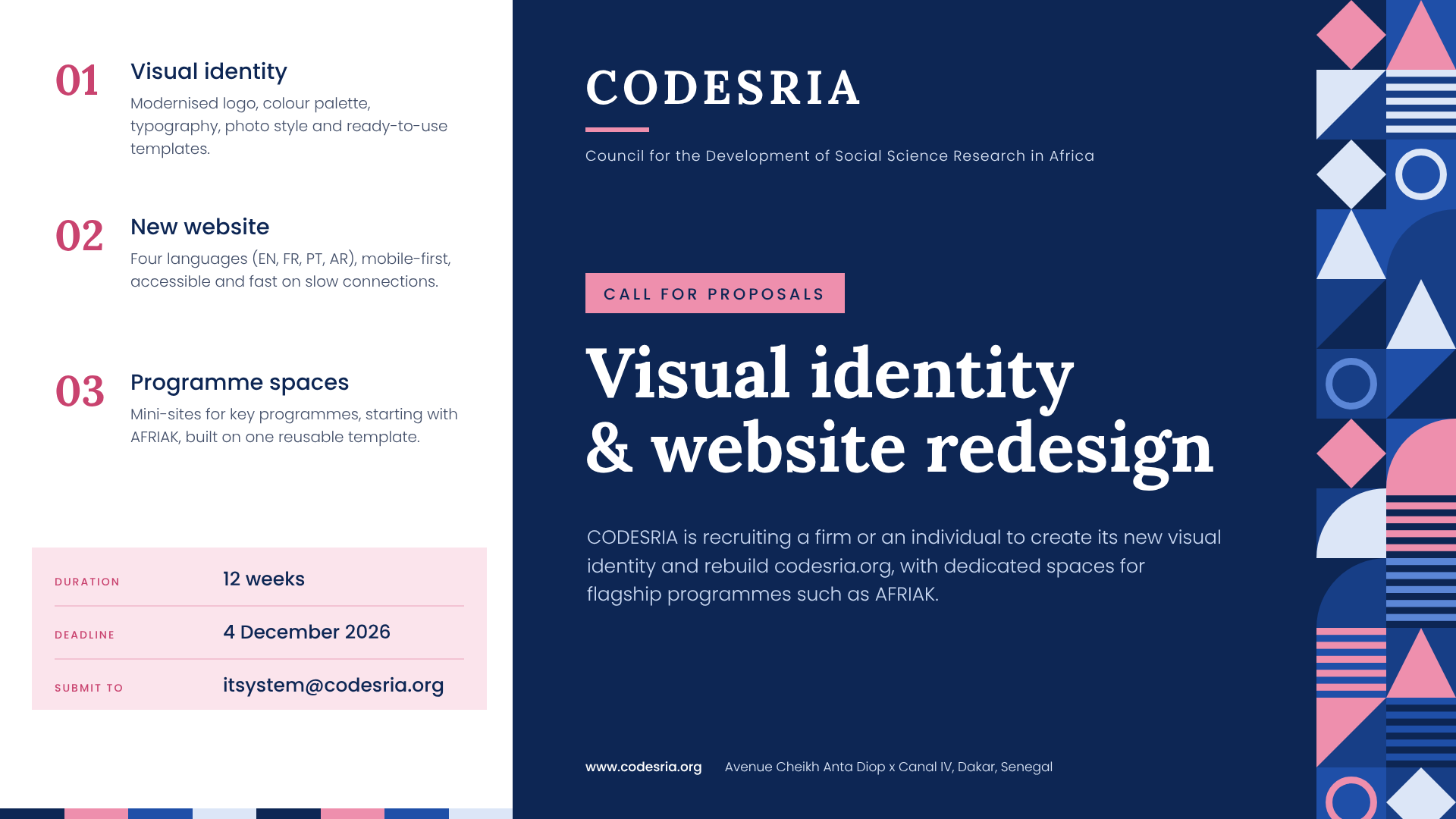
ToR – Visual Identity Guidelines and Redesign of the CODESRIA Website
CODESRIA is looking for a service provider (firm or individual) to design new visual identity guidelines (branding guide) and fully redesign its website, codesria.org, with dedicated spaces for its flagship programmes such as AFRIAK and others.
1. Background and Rationale
1.1 About CODESRIA
The Council for the Development of Social Science Research in Africa (CODESRIA) is an independent, pan-African, non-governmental research organisation founded in 1973 by African researchers (About us). Its headquarters are in Dakar, Senegal, where it enjoys diplomatic status.
Its mission is to promote social science and humanities research in Africa and to strengthen African knowledge production in support of the continent’s transformation. It serves researchers on the continent and in the diaspora.
The Council is governed by a General Assembly (held every three years), a 10-member Executive Committee representing the five sub-regions, a Scientific Committee and an Executive Secretariat based in Dakar. Its work is guided by the Charter (revised in 2015) and the 2023-2027 Strategic Plan.
The Strategic Plan rests on three scientific programmes:
- Research: Meaning-Making Research Initiatives (MRI), advanced research fellowships, working groups.
- Training, Grants and Fellowships: annual thematic institutes, the Diaspora Project, the College of Mentors, AFRIAK.
- Publications and Dissemination: books, scholarly journals, CODESRIA Bulletin, Africa Development, Journal of Higher Education in Africa, etc.
CODESRIA is supported by, among others, Norad, Sida, the Mastercard Foundation, Carnegie Corporation and the Government of Senegal. It works with partners such as UNESCO, CLACSO, the HSRC and the Arab Council for the Social Sciences.
1.2 The AFRIAK programme, a priority use case
AFRIAK (African Fellowships for Research in Indigenous and Alternative Knowledges) is implemented with the Mastercard Foundation. It combines three components: research, training and mentoring for young researchers; policy dialogues; and an alumni network and community of practice.
Today, AFRIAK does not have its own space on the website, just a few pages. Its calls are published as ordinary news items in English, French and Portuguese, and applications go through a separate platform. The programme deserves a showcase that matches its visibility among young researchers and with its funder.
1.3 Current state of the website and visual identity
The current website runs on WordPress with a commercial theme and plugins. A quick review highlights the following issues:
| Finding | Impact on visitors |
| Incomplete French version: menu labels in English (“Who we are”, “Our Organs”, “Conferences”) | Inconsistent experience for French-speaking audiences |
| Only two languages (EN, FR), although the Council also publishes in Portuguese and Arabic | Portuguese- and Arabic-speaking communities poorly served |
| Broken links and incorrect labels (e.g. “Strategic Plan 2023 – 2023” pointing to 2022-2026) | Loss of trust, information hard to find |
| Several versions of the logo uploaded with no usage rules | Visual identity varies from one medium to another |
| Key programmes (AFRIAK, MRI, institutes) buried in the third menu level or in the news section | Target audiences do not find calls in time |
| Scattered satellite platforms (journals, bookshop, submissions, catalogue, membership) with no shared navigation | Fragmented user journey, each platform has its own look |
CODESRIA currently has no formal visual identity guidelines governing the use of the logo, colours, typefaces and images on the web, in publications and at events. The website redesign is an opportunity to lay this common foundation.
2. Objectives of the Assignment
2.1 Overall objective
To provide CODESRIA with a consistent visual identity and a modern, attractive, easy-to-navigate institutional website that reflects its standing as the leading pan-African social science research institution and gives strong visibility to its programmes.
2.2 Specific objectives
- Create comprehensive visual identity guidelines that modernise CODESRIA’s identity while staying true to its history of more than 50 years, and that apply to the web, publications, social media, events and communication tools.
- Make the website beautiful and lively: a warm, bold colour palette inspired by the continent, and real photos of CODESRIA’s activities (researchers, General Assemblies, institutes, fellows) rather than generic stock images.
- Make information easy to access: a clear site structure, an effective search engine, and access to calls for applications, publications and programmes in no more than three clicks.
- Give key programmes their own space: dedicated pages or sub-sites for AFRIAK, MRI, the thematic institutes and the Diaspora Project, each with its own identity derived from the guidelines.
- Serve every audience in its own language: English, French, Portuguese and Arabic (with right-to-left display for Arabic).
- Unify the experience between the main website and existing platforms (OJS journals, bookshop, catalogue, etc.) through shared navigation and a common look.
- Make the CODESRIA team self-sufficient in publishing, translating and updating content without relying on the provider.
- Ensure a secure, fast and accessible website, including on mobile devices and slow connections, which are common for part of the African audience.
3. Scope and Description of Services
The assignment comprises two lots, awarded to a single provider or to a consortium. Lot 1 must be approved before work starts on the graphic mock-ups for Lot 2.
3.1 Lot 1: Visual identity guidelines
Assessment and positioning
- Audit of the current identity (logo and its variants, colours, printed materials, social media, publications).
- Workshops with senior management, the three programmes and the communication team to define the desired image: institutional, pan-African, scholarly yet open to young people.
- Presentation of 2 to 3 creative concepts, then refinement of the selected concept.
Logo
- Modernisation of the existing logo (not a replacement, unless CODESRIA decides otherwise): main, horizontal, vertical, monochrome and reversed versions, icon/favicon.
- Usage rules: clear space, minimum size, misuses, co-branding with partner logos (Mastercard Foundation, Norad, Sida, etc.).
Colours and typography
- Primary and secondary palettes, with CMYK, RGB, HEX and Pantone codes, and contrast checked for web accessibility.
- Accent colours for each programme (AFRIAK, MRI, institutes, publications) so that each space is recognisable while remaining part of the same family.
- Royalty-free typefaces (such as Google Fonts) covering the Latin and Arabic scripts.
Images and iconography
- Photographic style: real photos, African women and men researchers at work, diversity of sub-regions, genders and generations, standard framing and colour treatment.
- Selection and retouching of an initial library of at least 60 photos from CODESRIA’s archives.
- A consistent set of icons and graphic patterns.
Applications
- Templates: letterhead, business card, PowerPoint presentation, report, book and journal covers, CODESRIA Bulletin, event poster and roll-up banner, email signature, social media visuals (posts, banners, stories), badge and certificate.
- At a minimum, an adapted kit for AFRIAK.
3.2 Lot 2: Website redesign
Design
- Audit of the existing website: content, traffic statistics, search engine optimisation, user journeys.
- Interviews or a survey with 4 audiences: researchers and fellows, members, partners and funders, the general public and the media.
- New site structure, user journeys and wireframes.
- Graphic mock-ups (home page, programme page, AFRIAK sub-site page, publication page, news item, call for applications, search, contact), in desktop and mobile versions.
Development
- Development of the website and templates, integration of the visual identity guidelines.
- Migration of relevant content from the old website in both existing languages, with 301 redirects from the old addresses.
- Set-up of the Portuguese and Arabic versions (structure and templates; translations are provided by CODESRIA, unless offered as a priced option by the provider).
- Visual alignment and links with existing platforms.
3.3 Dedicated spaces for key programmes
Each flagship programme has a space that works like a mini-site, with its own accent colour, menu and home page, but is managed in the same tool as the main website. It is reachable through a short address (e.g. codesria.org/afriak or afriak.codesria.org).
The first space to be delivered is AFRIAK. It includes at a minimum:
- Presentation of the programme, partnership with the Mastercard Foundation, research themes.
- Current call with a countdown, eligibility, FAQ and a direct link to the application platform.
- Directory of fellows by cohort (photo, country, project), with filters.
- Results and publications from the programme, selection reports.
- Policy dialogues and events.
- Alumni space and community of practice.
- Photo and video gallery.
- Archives
The template must be reusable to create other spaces without additional development: MRI, annual thematic institutes, the Diaspora Project, the College of Mentors and future initiatives.
3.4 Out of scope
- Functional redesign of the OJS, bookshop, Koha catalogue and member area platforms (only their look and shared navigation are expected, see section 4).
- Production of new editorial content and translations (unless offered as an option).
- On-site photo shoots (option to be priced separately).
4. Functional and Technical Requirements
4.1 Proposed site structure
The provider will refine this proposal after the audit. The main menu should remain short (6 to 7 items):
- Home: key message, open calls, flagship programmes, latest publications, news, events calendar, key figures.
- About us: history, Charter, Strategic Plan, governing bodies (General Assembly, Executive Committee, Scientific Committee, Secretariat), staff, partners, annual reports.
- Programmes: Research; Training, Grants and Fellowships; Publications and Dissemination, with direct access to the AFRIAK, MRI, institutes and Diaspora Project spaces.
- Opportunities: all open calls (fellowships, grants, conferences, vacancies), filterable by type, audience and deadline.
- Publications: books, journals, CODESRIA Bulletin, reports, with links to the bookshop, journals and catalogue.
- News and events: news, events calendar, General Assembly, media library (photos, videos, podcasts).
- Membership and Contact, plus a visible Donate
4.2 Required features
| Feature | Requirement |
| Multilingual | EN, FR, PT, AR; visible language switcher; right-to-left Arabic; translated URLs |
| Search | Site-wide search with filters (content type, programme, language, year) |
| Calls for applications | Dedicated content type with deadline, automatic status (open / closed), archiving, email alerts |
| Publications | Records with cover, abstract, authors, ISBN/DOI, PDF download, purchase link |
| Events calendar | Events with date, venue, related programme, add to calendar |
| Profiles | Pages for members of the governing bodies, staff and fellows, with photos |
| Media library | Photo galleries, embedded YouTube videos, filtering by event |
| Newsletter | Sign-up and integration with the mailing tool chosen by CODESRIA |
| Sharing | Social media buttons and well-designed link previews. |
| Analytics | Privacy-friendly analytics tool, with a consent banner |
| Forms | Contact and information request forms, protected against spam |
4.3 Integration with existing platforms
The main website serves as the single gateway to CODESRIA’s digital ecosystem. The provider supplies a shared header and footer, as well as a light skin (logo, colours, typefaces) that can be applied to the following platforms:
| Platform | Address | Purpose |
| Journals (OJS) | journals.codesria.org | Scholarly journals and CODESRIA Bulletin |
| Applications | apply.codesria.org | Management of calls and grants |
| Book publishing | publication.codesria.org | Manuscript submission |
| Bookshop | bookshop.codesria.org | Book sales |
| Catalogue | codesria.bibliovation.com | Library (Koha) |
| Community | community.codesria.org | Membership and member area |
Where possible, the latest journal publications and the open calls on the application platform are displayed automatically on the website (RSS feeds, API or OAI-PMH).
4.4 Technical requirements
- CMS: open source, widely used and maintained, with a developer community in Dakar. WordPress remains acceptable if it is rebuilt properly (custom or lightweight theme, with no reliance on heavy page builders). The choice must be justified in the proposal.
- Ownership: CODESRIA owns the code, mock-ups, source files and accounts. No restrictive licences and no dependence on a personal account of the provider.
- Usability: mobile-first design; keyboard navigation; readable text.
- Accessibility: WCAG 2.1 level AA compliance (contrast, alternative text, structured headings).
- Performance: lightweight pages (target < 2 MB for the home page), optimised images (WebP/AVIF), lazy loading, caching and CDN; Lighthouse mobile score ≥ 85 for performance and ≥ 90 for accessibility.
- Search engine optimisation: clean URLs, meta and hreflang tags for each language, XML sitemap, structured data (organisation, events, publications).
- Security: HTTPS throughout, security headers, easy updates, role-based accounts (administrator, editor, translator, programme contributor), two-factor authentication for administrators, tested automatic backups.
- Hosting: the provider describes the recommended environment (server, staging environment, backups, monitoring). Deployment takes place on the infrastructure approved by CODESRIA’s IT Department.
- Personal data: compliance with Senegalese Law No. 2008-12 on personal data and GDPR good practice for European audiences.
5. Expected Deliverables
Each deliverable is approved in writing by the steering committee before payment of the corresponding instalment.
| No. | Deliverable | Format | Lot |
| L1 | Inception report: detailed work plan, methodology, list of content to be supplied | 1 and 2 | |
| L2 | Audit report (visual identity, website, statistics, audiences) | 1 and 2 | |
| L3 | Creative concepts (2 to 3), then the selected concept finalised | PDF + presentation | 1 |
| L4 | Complete visual identity guidelines (brand guide) | PDF + source files (AI, SVG, PNG, fonts) | 1 |
| L5 | Template kit (office, print, social media) and library of 60 processed photos | Editable source files (PSD, AI, Word, PowerPoint, Canva or Figma, InDesign) | 1 |
| L6 | Site structure, user journeys and wireframes | Figma or equivalent | 2 |
| L7 | Desktop and mobile graphic mock-ups, including the AFRIAK sub-site | Figma or equivalent | 2 |
| L8 | Website on staging, content migrated, complete EN and FR versions, PT and AR structure | Test URL | 2 |
| L9 | Test report (browsers, mobile devices, accessibility, performance, security) | 2 | |
| L10 | Launch of the website and the AFRIAK sub-site, redirects active | Live website | 2 |
| L11 | Technical documentation (installation, deployment, extensions, backup) and illustrated editor’s guide | PDF + short videos | 2 |
| L12 | Training: administrators (IT Department) and editors (communication, programmes) | Sessions + materials | 2 |
| L13 | Complete source code, access rights and credentials handed over to CODESRIA | Git repository | 2 |
After launch, the provider offers a 6-month warranty (bugs fixed at no cost).
6. Methodology, Timeline and Project Management
The assignment lasts 12 weeks (3 months) from contract signature to launch, followed by a 6-month warranty period. This short timeline assumes that phases overlap and that CODESRIA provides content and feedback without delay. The provider may propose a different timeline if justified.
Indicative timeline · 6 phases, 4 milestones, 12 weeks
The visual identity guidelines must be approved (end of week 4) before the mock-ups are finalised; development starts once the mock-ups are approved (end of week 6). Wireframes are prepared alongside the guidelines to save time.
6.1 Expected approach
- Participatory approach: workshops with the Executive Secretariat, the Deputy Executive Secretariat, the three programmes, administration, the IT unit; mock-ups tested with a sample of users (researchers, AFRIAK fellows, partners).
- Iterative work: interim versions presented every week, with two rounds of revisions included per deliverable.
- Staging environment accessible to CODESRIA throughout development.
- Skills transfer on an ongoing basis, so that the in-house team can maintain the website as soon as the assignment ends.
6.2 Project management
- Steering committee: Executive Secretary (or a representative), heads of the three programmes, Lead IT Manager, IT Manager, Programme Managers. It approves each deliverable and each milestone.
- CODESRIA project team: a communication focal point (content, photos, editorial approval) and an IT focal point (technical matters, hosting, security, access to existing platforms).
- Meetings: weekly progress meeting (online, 30 minutes) and written minutes after each meeting.
- CODESRIA’s commitments: provide content, archive photos, partner logos and technical access within the agreed timeframes; give feedback on each deliverable within 3 working days.
6.3 Indicative payment schedule
| Stage | Approved deliverables | Share of contract value |
| Inception | L1 | 20% |
| Visual identity guidelines approved | L2 to L5 | 25% |
| Mock-ups approved | L6, L7 | 15% |
| Acceptance on staging | L8, L9 | 20% |
| Launch, training and handover | L10 to L13 | 15% |
| End of warranty period | All issues resolved | 5% |
7. Provider Profile, Proposal and Evaluation
7.1 Required profile
An agency or consortium (design agency + development company) with:
- At least 5 years of experience in visual identity and institutional websites.
- At least 3 references for multilingual websites built for international organisations, universities, research centres or NGOs, including at least one in Africa.
- Experience with multilingual sites including Arabic (right-to-left), or a qualified partner.
- A sound understanding of accessibility and performance issues in low-bandwidth contexts.
Minimum proposed team:
| Role | Minimum experience |
| Project manager | 5 years, managing institutional web projects |
| Art director / graphic designer | 5 years, visual identity guidelines |
| UX/UI designer | 3 years |
| Lead developer(s) | 5 years on the proposed CMS |
| Photographer / retoucher | 3 years (may be a partner) |
7.2 Content of the proposal
Technical proposal
- Understanding of the assignment and initial observations on the current website.
- Methodology, creative approach and justified choice of technology.
- Detailed work plan.
- Team CVs and references (with links to completed websites and client contacts).
- Portfolio of 3 to 5 completed visual identity projects.
Financial proposal
- Detailed price per lot and per deliverable, in CFA francs (XOF), excluding taxes.
- Separately priced options: PT and AR translations, photo shoots.
- Validity of the proposal: 90 days.
7.3 Evaluation criteria
Proposals are evaluated using the quality- and cost-based method. Only technical proposals scoring at least 70 out of 100 points proceed to the opening of financial proposals.
| Criterion | Points |
| Understanding of the assignment and quality of the methodology | 20 |
| Creative quality of the portfolio and references | 25 |
| Company experience (institutional websites, multilingual sites, Africa) | 20 |
| Qualifications of the proposed team | 20 |
| Relevance of the technical choice, security, accessibility, handover plan | 15 |
| Total technical proposal | 100 |
Final score = 70% technical score + 30% financial score. Shortlisted bidders may be invited to present their proposal (in person in Dakar or online).
7.4 Submission procedure
- Technical and financial proposals must be submitted as two separate PDF files, in English or French.
- Submission address: itsystem@codesria.org.
- Deadline: 4 December 2026.
- Requests for clarification: in writing, no later than 7 days before the deadline; answers are shared with all bidders.
- CODESRIA reserves the right not to proceed with the call, to award only one lot or to negotiate with the highest-ranked bidder.