






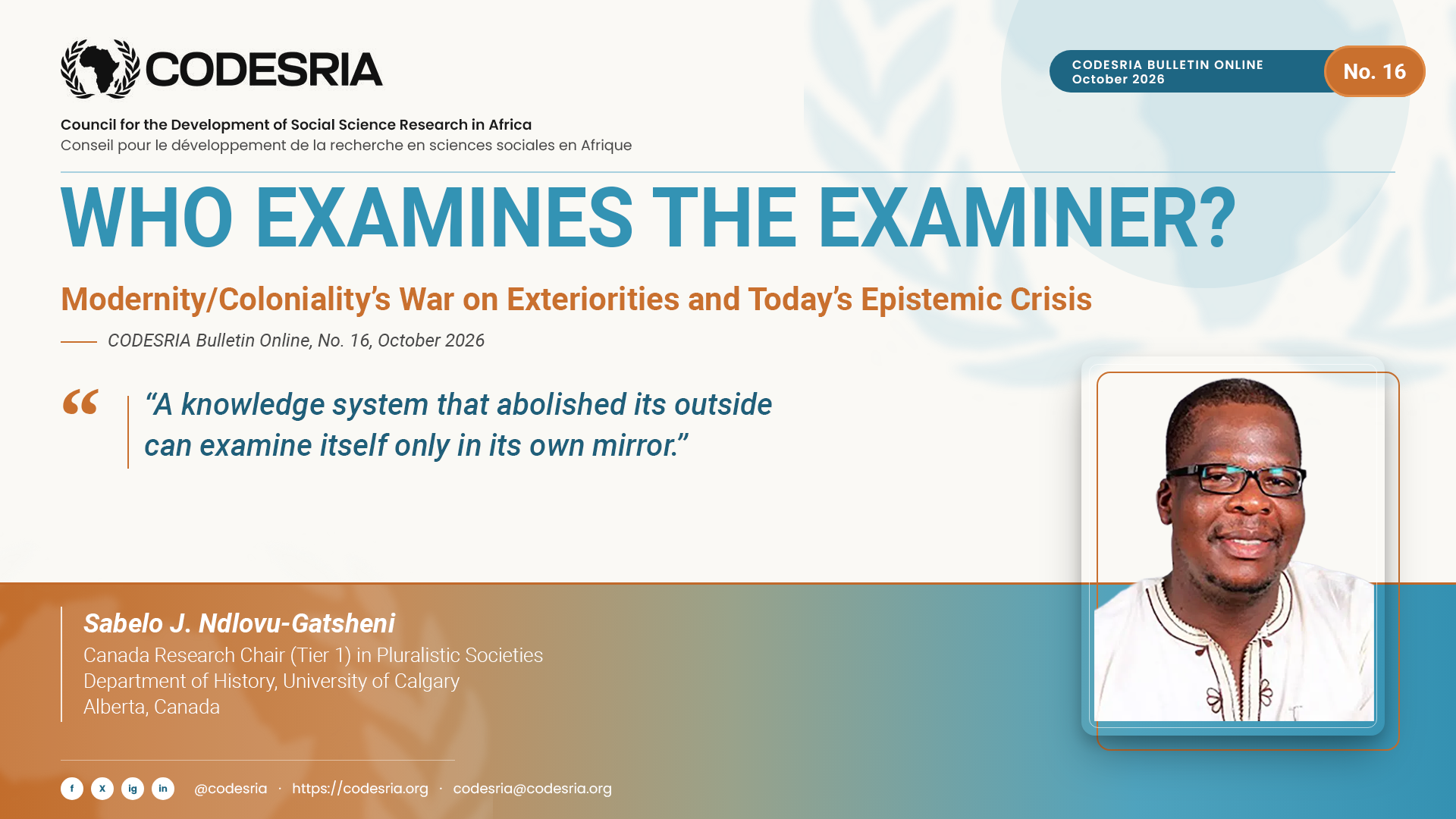
Who Examines the Examiner? Modernity/Coloniality’s War on Exteriorities and Today’s Epistemic Crisis
CODESRIA Bulletin Online, No. 16, October 2026
By Sabelo J. Ndlovu-Gatsheni, Canada Research Chair (Tier 1) in Pluralistic Societies: Epistemic Pluralism and Ecologies of Knowledges, Department of History, University of Calgary, Alberta, Canada.
A theatre in the seminar room
Picture a scene that takes place in thousands of universities every week. A doctoral candidate sits before a panel. On the panel is a figure invested with a special aura: the external examiner. She has flown in from another university, perhaps from another continent. Her task is to guarantee that the thesis has been judged not by those who nurtured it but by someone standing outside, someone whose distance makes her verdict trustworthy. The same ritual is repeated in the grant office, where applications are sent to external reviewers; in the journal, where manuscripts go to external peer reviewers; in the hiring and promotion committee, where dossiers are dispatched to external referees. Modern knowledge, it seems, is obsessed with exteriority. It will not certify itself without the blessing of an outsider.
I want to begin with a question that sounds naïve but is, I think, unavoidable: external to what? The external examiner who assesses a thesis in Calgary, Cape Town, Delhi or Bogotá was trained in the same kind of university, schooled in the same canon, disciplined by the same protocols of evidence and citation, published in the same indexed journals and ranked by the same league tables as the candidate she examines. She is external to the department. She is not external to the knowledge system. She is an insider who has been asked, for an afternoon, to act as an outsider. The external examiner is an interior figure performing exteriority.
I am not joking here. I am writing about an epistemic crisis. I am pointing to what I consider the original sin of the hegemonic knowledge system that today presents itself as simply ‘knowledge’. It became universal by waging a scorched-earth war on all its exteriorities, on other ways of knowing, being, living and doing. And having destroyed, disciplined and colonised those exteriorities into interiors, it now stages elaborate rituals of external validation to conceal the fact that it has no outside left. The present planetary epistemic crisis, I argue, is rooted in this condition. A knowledge system that abolished its outside can examine itself only in its own mirror. It has become player and referee at once. And we are now living through the consequences.