






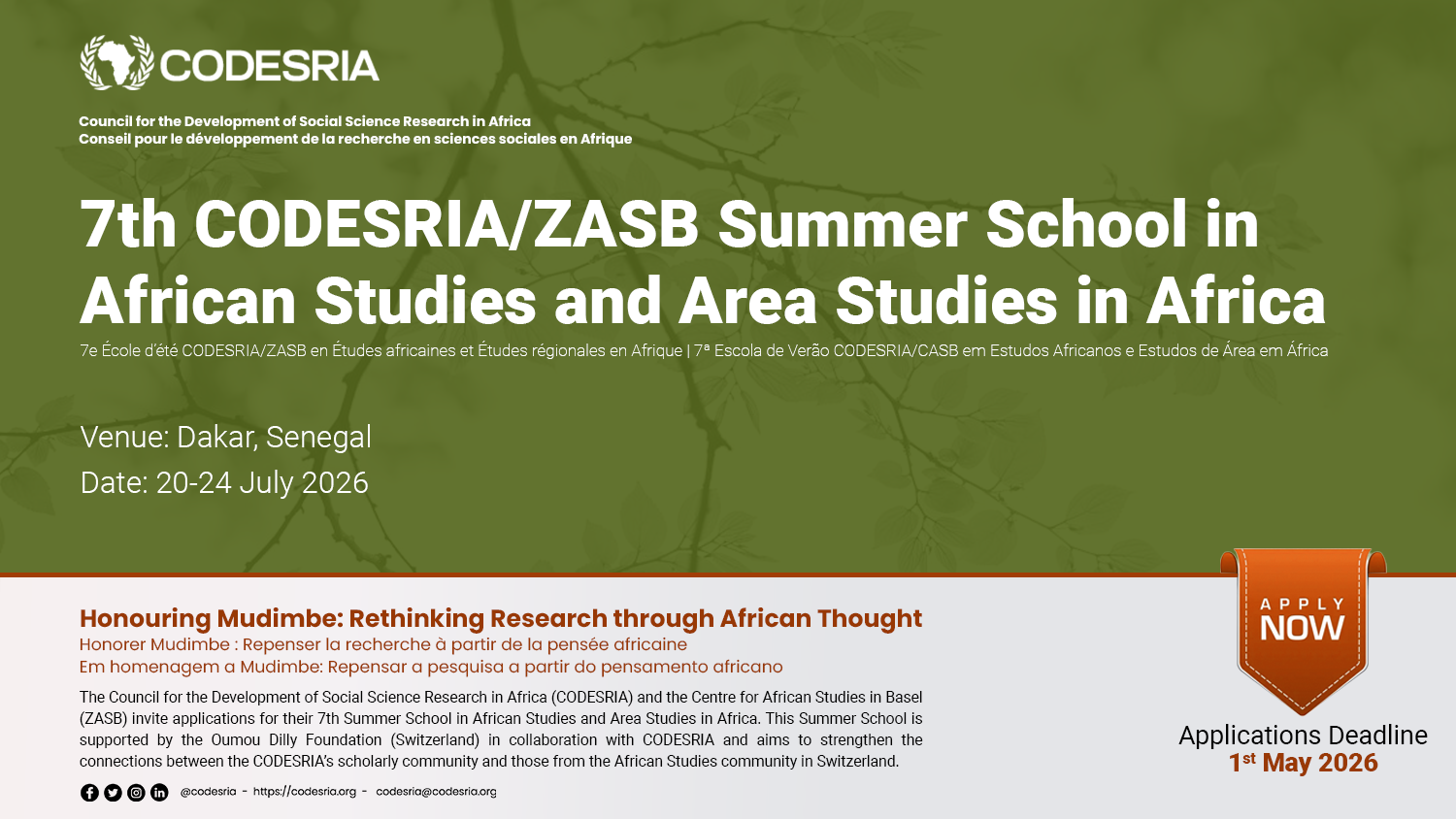
7th CODESRIA/ZASB Summer School in African Studies and Area Studies in Africa
Theme: Honouring Mudimbe: Rethinking Research through African Thought
Venue: Dakar, Senegal
Date: 20-24 July 2026
Applications deadline: 1st May 2026
The Council for the Development of Social Science Research in Africa (CODESRIA) and the Centre for African Studies in Basel (ZASB) invite applications for their 7th Summer School in African Studies and Area Studies in Africa. This Summer School is supported by the Oumou Dilly Foundation (Switzerland) in collaboration with CODESRIA and aims to strengthen the connections between the CODESRIA’s scholarly community and those from the African Studies community in Switzerland.
The primary aim of the Summer School is to foster and strengthen interdisciplinary approaches to research concerning Africa and other global regions from an African perspective. It emphasises African Studies as a facet of Area Studies and endeavours to identify themes that are theoretically, conceptually, and methodologically pertinent to the intellectual examination of Africa as a subject of knowledge. Furthermore, it seeks to assess Africa’s contribution to general scholarship while exploring the applicability of these findings to African perspectives on other regions.
The goals of the Summer School are as follows:
- Under the guidance of senior scholars, provide current PhD students and early career scholars with the opportunity to engage critically with new theoretical, conceptual, and methodological issues relating to African Studies relevant to their work.
- Stimulate participants to reflect on the potential relevance of African epistemology and ontology in enhancing theoretical, conceptual, and methodological tools in their disciplines and interdisciplinary work.
- Foster among summer school beneficiaries a sense of belonging to a community of scholars in pursuit of African-informed scholarship.
- Support emerging scholars to work towards carving a niche for African Studies in the broader field of scholarship, thereby helping African Studies to claim a place at the centre of knowledge production in Africa and globally.
The Summer School provides a venue for young SSH scholars to explore the challenges and opportunities that arise from balancing scholarly standards with social impact in Africa. Laureates of the Summer School will consider how their research can contribute to societal change, enhance their theoretical and methodological abilities in both interdisciplinary and transdisciplinary collaboration, and learn to position themselves within various academic and policy contexts from an African perspective.
Concept Note:
Valentin-Yves Mudimbe’s passing on April 22, 2025, marks the end of his extraordinary intellectual journey and offers a compelling invitation to remember his work and think anew. As one of Africa’s most insightful thinkers, Mudimbe not only provided a formidable critique of colonial knowledge systems, but he also left us a challenge: to envision a new future for research on and from Africa, where African conceptual creativity takes centre stage.
Mudimbe’s legacy encompasses literature, philosophy, history, anthropology, and more. His concepts—most notably the “Colonial Library” and “The Invention of Africa”—reveal the epistemological framework through which Africa has been interpreted, disciplined, and constrained within global knowledge systems. Yet, for Mudimbe, critique alone was insufficient. His deeper aspiration was to open intellectual space for African thought to emerge as a valuable resource for global scholarship.
This Summer School seizes the moment of his passing not only to commemorate but also to respond. It invites a new generation of researchers to grapple with the foundational question Mudimbe raised: How can African Studies contribute not only to better knowledge about Africa, but also to the renewal of the very tools through which we produce knowledge, namely, concepts, theories, and methods?
Building on the foundations laid by the earlier Summer Schools, which collectively redefined the place of African scholarship in rethinking research design, knowledge transfer, and the social relevance of inquiry, the 2026 edition seeks to move this reflection a step further. We will use this opportunity to explore how African Studies can truly become a generative and transformative discipline from within by integrating African epistemologies, philosophies, and critiques into the heart of scholarly practice. Participants will be encouraged to reflect critically on their doctoral projects in relation to this framework. In their concept paper, they may address some of the guiding questions below:
- How do inherited disciplinary concepts fare when applied to African contexts?
- How does your research reproduce, challenge or unsettle Mudimbe’s notion of the “Colonial library”?
- What do African critiques of knowledge reveal about the assumptions underpinning our methods?
- In what ways can African intellectual traditions contribute to the reimagining of the social sciences and humanities?
- What does it mean, in your case, to work not just on Africa, but with African thought?
- Which aspect of Mudimbe’s legacy do you find most challenging or unresolved, and why?
By grounding these questions in the work of Mudimbe and other African thinkers, the Summer School seeks to inspire a shift from African Studies as an object of critical enquiry to African Studies as a source of conceptual innovation. This is not simply a call for decolonisation in the abstract sense. It is an invitation to rebuild and move beyond critique toward the challenging but exciting task of conceptual reconstruction. It is a call to imagine African Studies not as a marginal or auxiliary field but as a site of theoretical production with relevance far beyond its geographic remit.
It is not only about re-reading African thinkers but about conceptual innovation: developing new categories and methods inspired by African languages, ethics, cosmologies, and epistemologies. We hope to create a space where doctoral students feel empowered to experiment intellectually, to belong to a community of scholars committed to critical rigour and conceptual risk-taking, and to see themselves not only as researchers of Africa, but as thinkers from Africa—regardless of their location. It is also envisioned as an intellectual forum that nurtures dialogue between the foundational works of African thinkers such as Mudimbe, Hountondji, and Wiredu, and the emerging voices of a new generation of scholars across the continent and the diaspora, fostering continuity, renewal, and collective imagination in African thought.
In honouring Valentin-Yves Mudimbe’s profound contributions, this Summer School not only commemorates his intellectual legacy but also actively advances his vision of transformative African Studies. By centring African epistemologies and fostering critical engagement with inherited disciplinary frameworks, it seeks to catalyse a paradigmatic shift from critique to conceptual innovation in the field. This endeavour challenges scholars to reconceptualise African Studies as a dynamic field of theoretical production with global significance, thereby fulfilling Mudimbe’s call to create new spaces in which African thought shapes and revitalises the social sciences and humanities.
Application procedures
The 7th CODESRIA/ZASB Summer School is calling for applications from doctoral students eager to engage with the above thematic focus within the broader context of engaging with conceptual, epistemological, and methodological frameworks in African Studies, social sciences, and the humanities.
The Summer School is open to Ph.D. students and early career scholars at Higher Education institutions on the African continent. Ph.D. students from Swiss universities are also encouraged. Applications will be considered from Ph.D. students in the Social Sciences and Humanities disciplines. Preference will be given to those in their first or second year of PhD enrolment.
Travel, accommodation, and meals during the Summer School will be provided for participants from African Institutions.
The Convenors of the Summer School are also open to receiving a limited number of applicants willing and able to pay the cost of participation.
Applications should include the following:
- Motivation or Application letter (max 500 words) with a clear statement demonstrating how your work would benefit from participation;
- Concept paper (max 2500 words) highlighting: (a) what you are working on, (b) how your research resonates with African or Global South conceptual and epistemological framings in general and with Mudimbe’s work in particular, (c) your expectations from the Summer School, and (d) a book relevant to the theme you have read or would like to read for discussion at the Summer School;
- A detailed Curriculum vitae;
- One letter of recommendation from the candidate’s institution of affiliation or their PhD supervisor;
- Passport copy;
- Copy or proof of PhD registration at an African or Swiss University (for PhD students), Copy of doctoral certificate for early career scholars.
Incomplete applications will not be considered for review.
In accordance with the Council’s academic integrity and research ethics standards, all submissions will be subject to plagiarism screening and AI-generated content detection. Submissions containing unattributed material, misrepresentation of authorship, or AI-generated content will be deemed ineligible.
Applicants are requested to use the following link https://codesria.org/summer-school-application-form/ to submit their proposals.
For specific questions, please contact:
CODESRIA SUMMER SCHOOL
tgf@codesria.org