






Conference Announcement – The Indelible Footprints of B. A. Ogot on the Sands of Time: History, Method and Knowledge Production in Africa
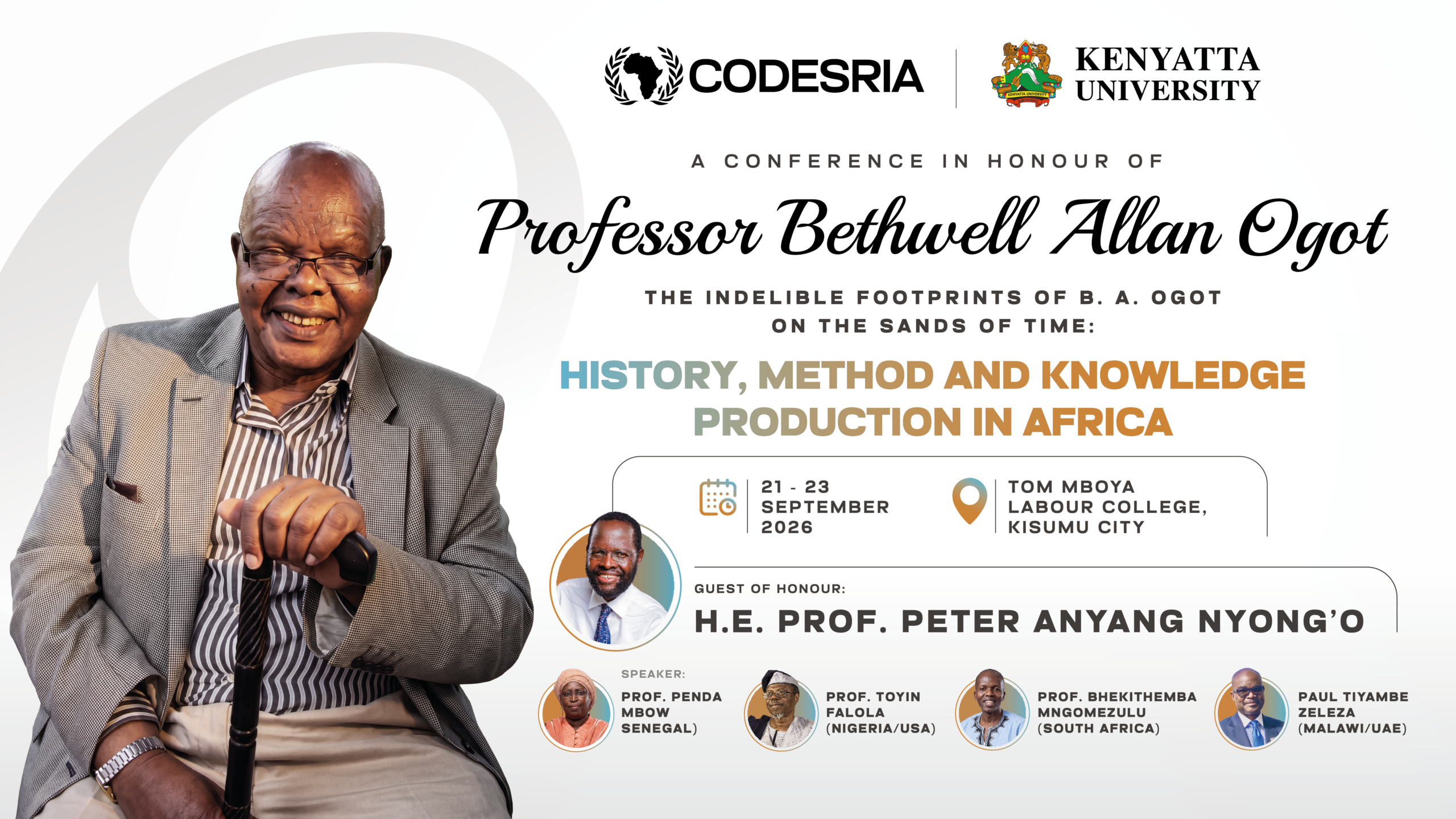
A conference jointly organised by the Department of History, Archaeology and Political Studies, Kenyatta University and the Council for the Development of Social Science Research in Africa (CODESRIA) in honour of Professor Bethwell Allan Ogot at Tom Mboya Labour College, Kisumu City, from 21 to 23 September 2026.
Prof. Bethwell Allan Ogot (1929 – 30 January 2025) is one of Africa’s most celebrated historians and a pioneering academic and intellectual. Nurtured and matured in the same tradition that gave us some of Africa’s most innovative thinkers, Prof. Ogot distinguished himself as a historian among his peers by seeking to reconstruct African history based on sources that his own teachers and mentors doubted could be legitimate sources of history. He intervened in the debate on whether Africa had a history in a unique and innovative way by using oral traditions as sources of history. Through his approach, he subsequently transformed the discipline by challenging colonial historiography and establishing African-centred approaches to the writing of history. His pioneering work demonstrates that Africa possesses rich historical traditions from long before the advent of European colonialism, which contributed significantly to the decolonisation of historical knowledge. While the agenda of decoloniality had yet to acquire this vocabulary, his extensive scholarship did what the vocabulary has only more recently caught up with. Prof. Ogot’s work on the history of the Southern Luo, his emphasis on the possibilities offered by oral traditions as sources of history, and his reflections on the experience of nationalism, and state formation led to the emergence of an African historiography that remains influential in universities across the world. His numerous publications, too many to dare a full citation here, continue to shape contemporary historical research and teaching globally. Beyond scholarship, he provided support to the Kenyan nationalist struggles, served with distinction as a university administrator, contributed as a public intellectual and advocate for African cultural heritage. Prof. Ogot also mentored generations of historians and leaders in academic institutions that laid the intellectual foundations for the growth of professional historical studies in Kenya, in East Africa and across the African continent.
Prof. Ogot was the founder and President of the Historical Association of Kenya (HAK) – a platform which convened historians in Kenya and the region. The HAK led publishing initiatives and ran, for a period, the Kenya Historical Review, where groundbreaking work on African history was published. By the time he retired as head of the HAK, his mark on the reconstruction of Kenyan history had become indelible. This included serving as Chair of the Board of Directors of the East African Publishing House, and the first Secretary General of the Jomo Kenyatta Foundation. Beyond Kenya, Ogot’s legacy was inextricably tied to his pivotal role in UNESCO’s General History of Africa project. This ambitious publishing programme sought to reconstruct Africa’s past, from antiquity to the postcolonial era, a monumental task undertaken at a time when the writing of history was dominated by Africanists. Together with esteemed historians like Joseph Ki-Zerbo, Adu A. Boahen, Jacob Ade Ajayi, D. T. Niane, M. El Fasi, Ivan Hrbek, Gamal Mokhtar and Ali Mazrui, to name but these few, Ogot challenged the prevailing Eurocentric narratives that denied Africa its history or positioned African history as dependant on temporal markers derived from European history.
In recognition of Prof. B. A. Ogot’s legacy, CODESRIA, in collaboration with the Department of History, Archaeology and Political Studies at Kenyatta University, will convene an international conference that brings together historians, social scientists and policymakers to embark on the journey of memorialising and canonising his work. The participants—drawn from Africa and beyond—will include colleagues, friends, family, former students and policy actors from the Kisumu City County and the national bodies responsible for the preservation of national cultures. In a nutshell, we anticipate both an intellectual and policy engagements during the three days meeting as the conference will also invite university faculty, administrators and graduate students.
The aim of the meeting is to reflect on Prof. Ogot’s remarkable intellectual contributions and work towards an appreciation of their relevance to contemporary debates on African history, knowledge production and the possibility of using his example as a pathway to influencing school curriculum for the teaching of history. The conference offers an important opportunity to honour one of Africa’s greatest historians while advancing critical conversations about the future of historical scholarship on the continent. By bringing together scholars from diverse disciplines and regions, the conference will celebrate an extraordinary legacy and reaffirm the central role of African historians in understanding Africa’s own historical experiences, intellectual traditions and aspirations.
Prof. B. A. Ogot taught at Kenyatta University (KU) from 1983 to 1991, before moving to Moi University and later to Maseno University, from where he retired. During his time at KU, a vibrant historical scholarship revolved around its Department of History, which had a seminar culture that attracted researchers from within the region and beyond. He inspired a range of students who came of age to command discourse at sophisticated levels. A ‘tome’ in his honour was published in 1989 under the title A Modern History of Kenya, edited by the late William Ochieng’ and comprising a series of essays mostly by his former students. It also included a rich bibliography of his works. KU, therefore, was an obvious institution of choice to partner in the convening of this meeting.
Prof. B. A. Ogot’s imprint on CODESRIA was made through a number of connected channels. Perhaps most significant was his role as President of the International Scientific Committee for the drafting of a General History of Africa, a role he accepted following the groundbreaking support extended to the community of African historians under the leadership of Amadou-Mahtar M’Bow (1921–2024), the first African Director-General of UNESCO. The influence here was indirect: the historians associated with the UNESCO project also influenced the shape of CODESRIA’s agenda. Other than Amadou-Mahtar M’Bow, who remained a strong pillar for CODESRIA and spoke at the 13th Triennial CODESRIA General Assembly in Rabat, Morocco in 2011, there was Joseph Ki-Zerbo, who was a life member of the Council and published extensively with CODESRIA. Many of the historians associated with this project also played a key role in the Association of African Historians, whose scientific publication, Afrika Zamani, CODESRIA supported until 2020, when it was formally returned to the association. In his role as the President of the International Scientific Committee for the drafting of a General History of Africa, a magnificent collection of books that represent the best of African historical thinking, Ogot presided over the publication of volumes that were edited by and brought together contributors who affirmed the existence of a vibrant community of scholarship in Africa. The UNESCO project, which initially published eight volumes and has recently launched three more, has acquitted itself as perhaps the most ambitious initiative of its kind ever undertaken, outrivalling the eight-volume The Cambridge History of Africa.
Although Prof. Ogot never made it to a CODESRIA function, it was not for want of trying. His role was a part of the SOS African History in 2008. Prof. Ogot accepted an invitation to be keynote speaker at the inaugural CODESRIA SOS African History Conference, originally scheduled to be held in Nairobi. He however was not able to make it once the meeting was moved to Kampala in October 2008.
In honour of this history and Prof B. A. Ogot’s enduring legacy, the conference collaboration between CODESRIA and KU will seek to attain the following key specific objectives:
- To examine and establish a prospective appreciation of B. A. Ogot’s contributions to African historiography.
- To locate this appreciation of B. A. Ogot’s work in the influence he brought to bear on the institutional development of history in Africa.
- To identify lessons and map out pathways through which his influence can be channelled for rethinking the study of African history, using it for mentorship and mapping the future for the next generation of historians.
- To identify and showcase contemporary research directions inspired by Professor Ogot’s work.
Taken together, these objectives aim to celebrate and carry Prof. B. A. Ogot’s legacy forward by ensuring that his work continues to inform how African history is studied and taught
What happened?
- Prof. Bethwell Allan Ogot Conference Programme
- Some Pictures from Day 1 and Day 2
- Some YouTube links from the conference ( Video1, Video2, Video3)
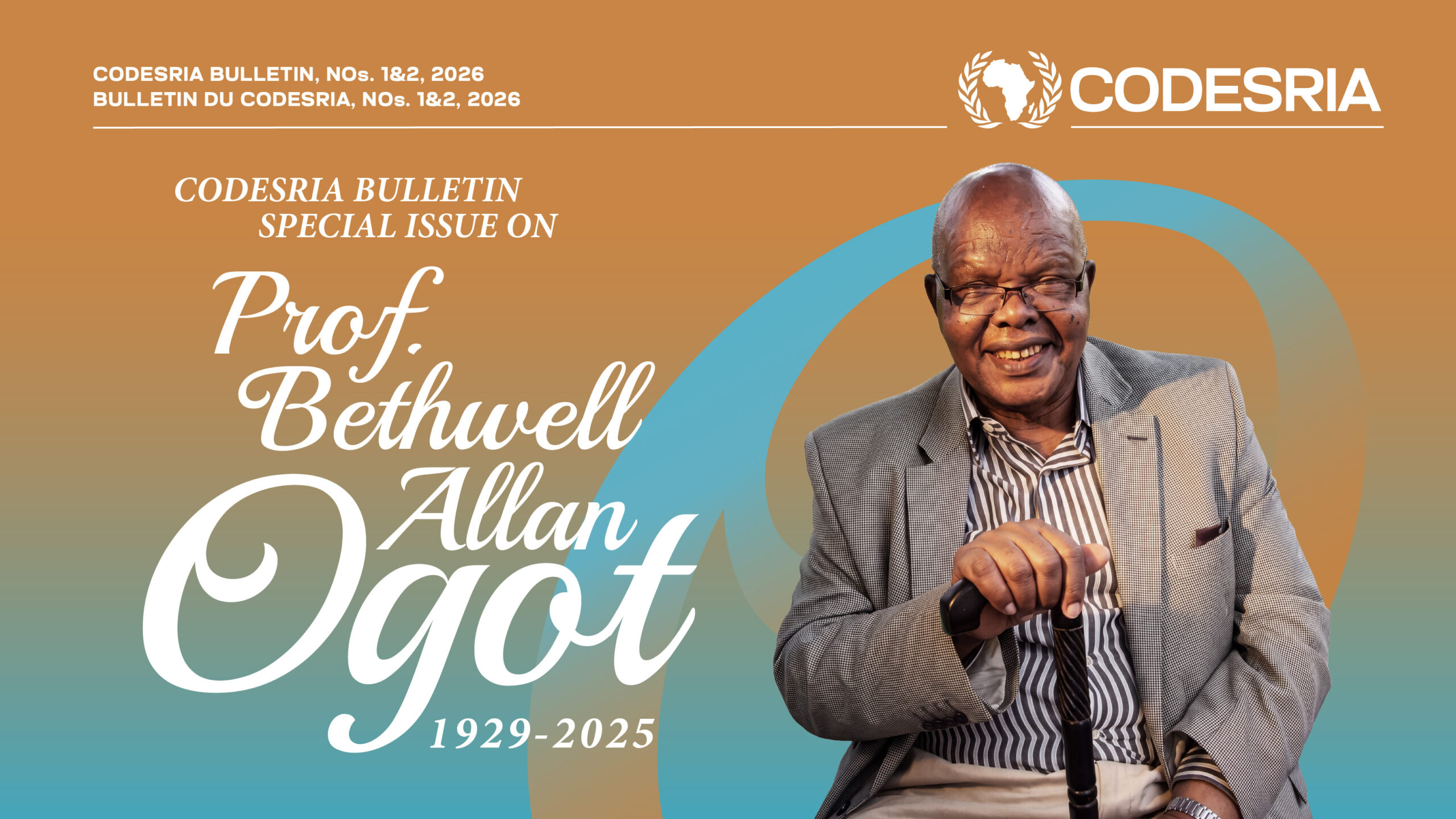
- CODESRIA Bulletin, Nos 01-02, 2026: Special Issue on Prof Bethwell Allan Ogot (1929-2025)