







The Making of the Essential Mamdani: Reading Citizen and Subject After Three Decades
CODESRIA Bulletin Online, No. 12, September 2026
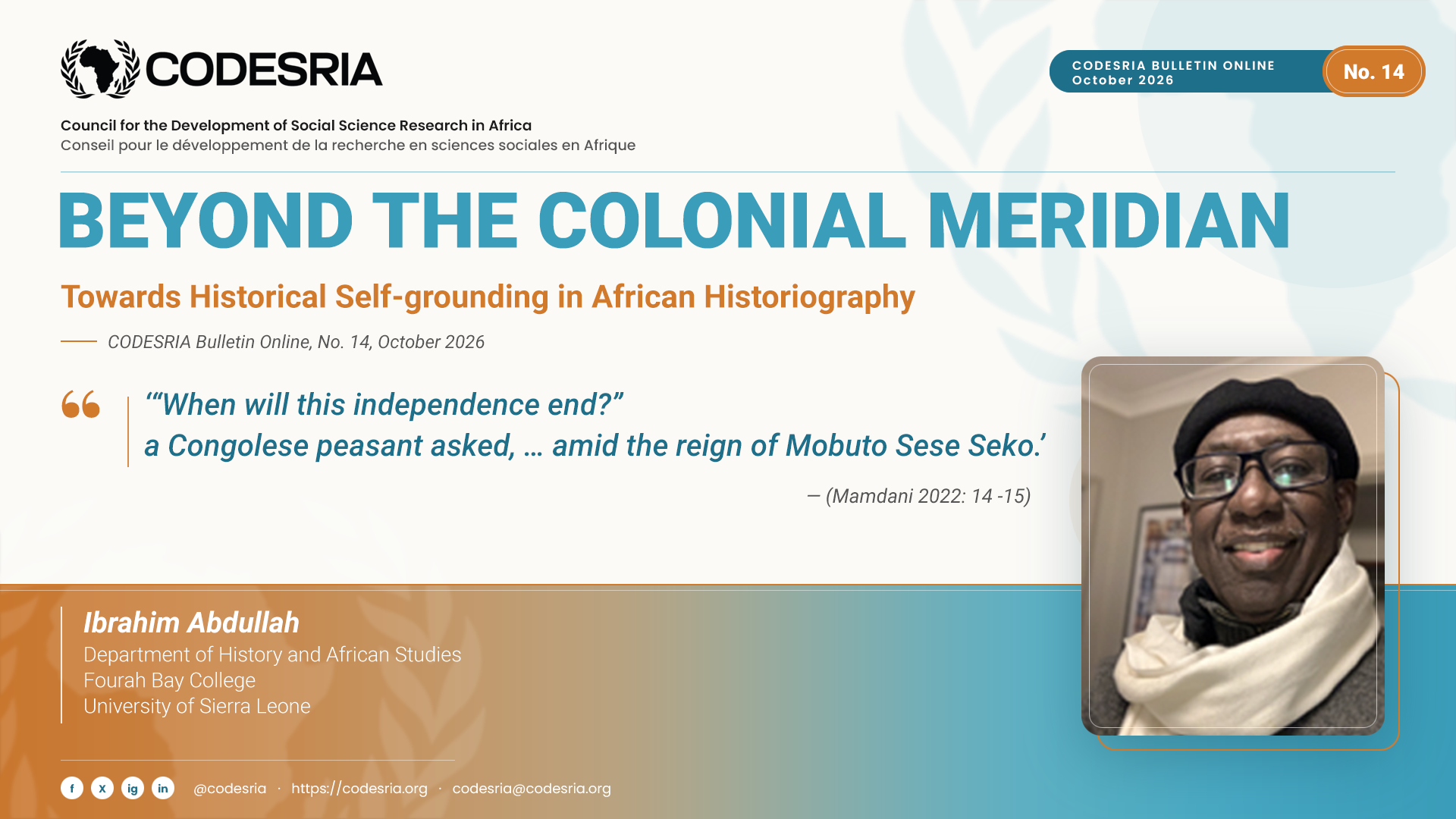
by Ibrahim Abdullah, Department of History and African Studies, Fourah Bay College, University of Sierra Leone
‘Each generation must out of relative obscurity discover its mission, fulfill it, or betray it.’ Frantz Fanon
La Problématique
Thirty years after the publication of Citizen and Subject: Contemporary Africa and the Legacy of Late Colonialism (1996), Mahmood Mamdani occupies an assured place in African political thought. Few books published in African studies since the 1990s have travelled as widely or supplied so durable a vocabulary for thinking about colonial rule and its aftermath. ‘Citizen’ and ‘subject’, the ‘bifurcated state’ and ‘decentralised despotism’ now circulate well beyond the historical arguments in which they were first formulated. Their portability is evidence of the book’s conceptual force. It is also the source of a problem.
As Citizen and Subject has become canonical, it has increasingly been read apart from the African intellectual world that made it possible. The book now often appears as a self-contained work of political theory, available for extension across colonial and postcolonial settings far beyond Africa. Such readings are productive, but they can produce a subtle dehistoricisation: the concepts travel while the institutional, political and scholarly formation from which they emerged recedes. The result is not simply an incomplete biography of Mamdani. It is a distorted history of African theory, one in which a collective intellectual achievement is retrospectively reorganised around the singular authority of a canonical author. Read More …