






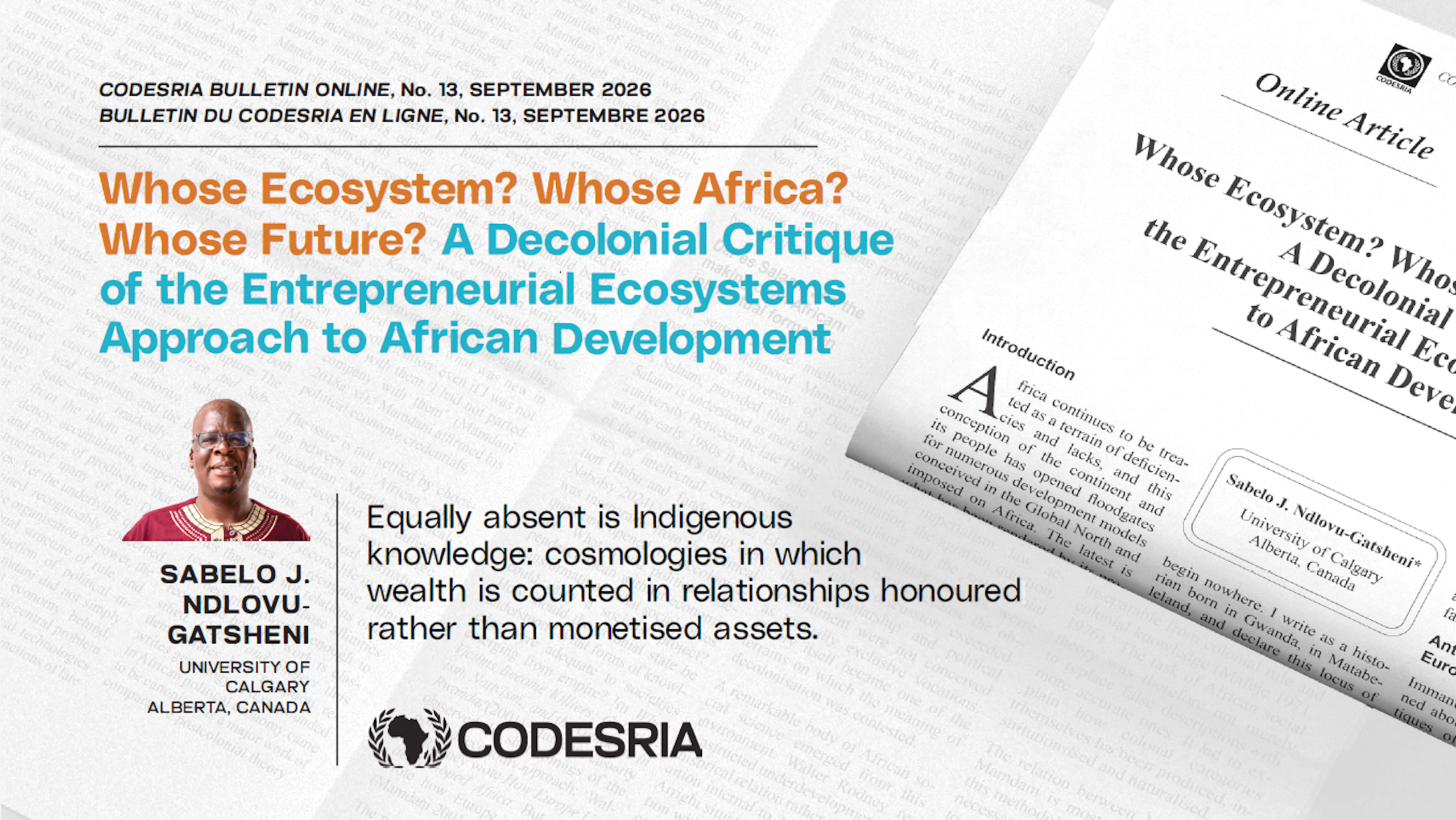
Whose Ecosystem? Whose Africa? Whose Future? A Decolonial Critique of the Entrepreneurial Ecosystems Approach to African Development
CODESRIA Bulletin Online, No. 13, September 2026
by Sabelo J. Ndlovu-Gatsheni, Professor of History and Canada Research Chair (Tier 1) in Pluralistic Societies: Epistemic Pluralism and Ecologies of Knowledges, University of Calgary, Alberta, Canada.
Introduction
Africa continues to be treated as a terrain of deficiencies and lacks, and this conception of the continent and its people has opened floodgates for numerous development models conceived in the Global North and imposed on Africa. The latest is what has been rendered by its proponents as “entrepreneurial ecosystems for Africa” which are driven by Silicon Valley models of development and are being imposed on Africa as magic wand for development of the African people. This article provides a decolonial critique to this continued imposition of models of development from Europe and North America and how their proponents and advocates try to hide the Eurocentrism of the models by using what they term African “stories” and African “voices” which they “harvest” to give their model an African tinge.
The event that provoked a decolonial critique
Every act of theorising begins somewhere, in a body and a biography, even when it pretends to begin nowhere. I write as a historian born in Gwanda, in Matabeleland, and declare this locus of enunciation because the trouble with much Northern theory is not that it is located but that it has forgotten it is located (Mignolo 2011). These reflections began as an invited response delivered on 9 July 2026 at a seminar convened by Eurac Research in Bozen-Bolzano in Italy, on Phumlani Nkontwana and Erik Stam’s ‘Entrepreneurial Ecosystems for the Africa we want’ (2023) —a serious and generous paper by scholars who plainly tried to shift the geography and biography of knowledge but failed because their theories remained Euro-North American-centric. The authors tried to compensate for this through a methodological approach, which in their words “harvested African stories.” What follows is a sympathetic critique of their sympathetic critique toward Silicon Valley prescriptions for African development, by an ally who insists it does not go far enough. Read More …